Operational Intelligence: Why Streaming Teams Need Faster Answers in 2026
Next in our series on our team’s 2026 Streaming Industry Predictions.
The streaming industry has never moved faster. Content licensing windows are shrinking, competitive catalogs shift daily, and subscribers churn with a single disappointing search result.
In this environment, yesterday’s data is already outdated.
We asked our team what operational decisions streaming and entertainment companies will need to make faster and more frequently in 2026, and what questions the business should be asking every single day.
Their responses reveal an industry racing to close the gap between data and decision-making.
Key Takeaways
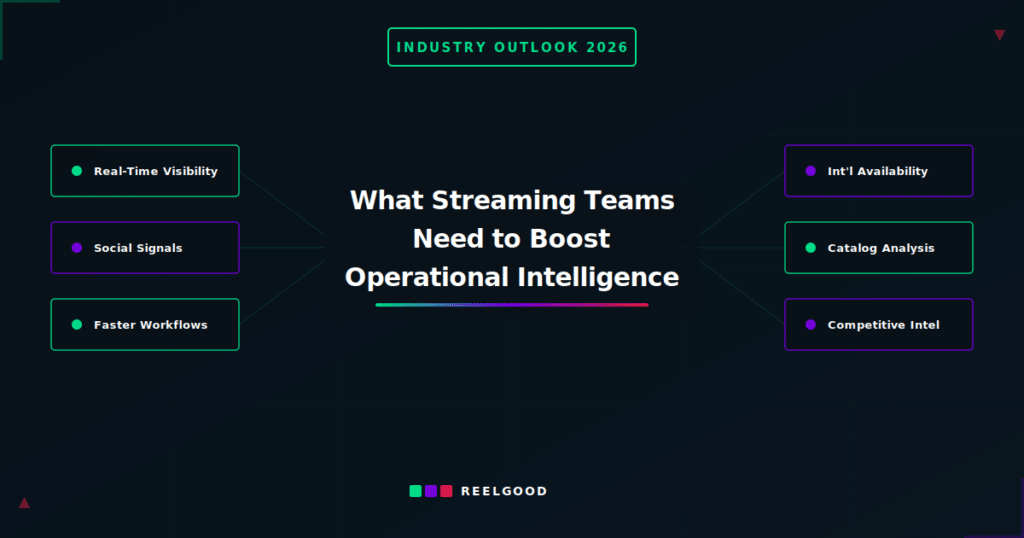
- The daily question that matters most: What do viewers want right now, and how do we deliver it before they switch to a competitor? Answering this requires integrating viewing data, social signals, and competitive intelligence in near real-time.
- Social sentiment is an untapped signal: Services that can detect when catalog titles trend on TikTok or other platforms, and respond with targeted placement or promotion, will capture attention competitors miss.
- Shorter licensing windows demand faster workflows: As content moves between services more frequently, teams need earlier warning on competitive availability shifts and must restructure around daily decision cycles rather than weekly reports.
The Daily Question That Defines Success
When we asked the team to identify the one question businesses should ask daily, the answers converged on a deceptively simple theme: understanding what viewers want right now, and what they’ll want next.
“The big question is: What do our consumers want to watch, and how do we deliver the best content possible so they don’t jump to another platform with so many options available?” says Miguel Callejas, Lead, Data Entry Team.
Carolina Tinajero of the Data Entry team frames it as a prediction challenge: “They need to know what people like at the moment and what they will enjoy in the near future. For this, they need to know exactly what people consume.”
This sounds straightforward, but answering it well requires integrating multiple data streams in near real-time: viewing behavior, search patterns, social signals, and competitive availability.
Real-Time Competitive Intelligence
One clear demand from the team: streaming services need faster visibility into what’s happening across the competitive landscape. (This aligns with what we identified in our metadata strategy post as a critical gap: real-time visibility into competitors’ and partners’ catalogs.)
Marina Germani, QA and Data Entry Analyst, identifies the key data points teams should track daily: “Audience metrics, potential user churn, competitor changes and content availability, and social media content.”
The challenge is that these signals live in different systems, update at different intervals, and require different expertise to interpret. Services that can integrate them into unified operational dashboards will have a significant edge.
The Social Sentiment Signal
Several team members pointed to an underutilized data source: real-time social media engagement as a leading indicator for content decisions.
Javier Moran, Engineering Manager, suggests a practical application:
“One could monitor social media posts for sentiment, matched to movie tags or specific client catalogs, allowing something like a ‘most talked about on TikTok‘ row.”
This approach turns social buzz into actionable programming intelligence.
When a catalog title suddenly trends on social platforms, services with the infrastructure to detect and respond quickly can capitalize with prominent placement, targeted notifications, or accelerated promotional spend.
Beyond the Top 10: Regional Granularity
Felipe Lemarie, Data Science Lead, points to a blindspot in how services currently measure success: “What content has been popular by region so they know what to acquire to expand. Understanding international data availability and new shows for discovery, and comparing and ranking popularity beyond the top 10, could prove extraordinarily valuable.”
Most services publish top-10 lists, but the acquisition and programming decisions that drive differentiation happen deeper in the catalog.
Understanding what’s performing at positions 11 through 100, and how that varies by market, requires more granular analytics than many services currently deploy.
Licensing Windows as Operational Levers
Pablo Lucio Paredes, Head of Engineering and Data, identifies a structural shift that will demand faster operational responses:
“Shorter licensing windows for content is probably best. The incentive of a piece of content leaving a platform seems valuable, which will make cross-platform catalog analysis more valuable to know what to license next.”
When content moves between services more frequently, the teams responsible for catalog planning need earlier warning signals about competitive availability shifts. What’s leaving competitors’ libraries? What’s entering? And how does that change the relative value of your own catalog week to week? With major deals reshaping the competitive landscape, this intelligence becomes even more critical.
Structuring Workflows to Avoid Bottlenecks
Answering these daily questions well requires more than better data. It requires rethinking how teams are structured to act on it.
The traditional model, where analysts pull data, build reports, and present findings to decision-makers, introduces too much latency for an environment where content relevance can shift overnight.
Services that embed real-time dashboards directly into programming and acquisition workflows will have a structural advantage over those still waiting for weekly reports.
This also means moving beyond siloed data systems. When social sentiment lives in one tool, competitive availability in another, and viewing data in a third, the analyst becomes the bottleneck. Integration isn’t just a technical problem; it’s an operational speed problem.
What It All Means
The streaming services that will thrive in 2026 are those that can shrink the gap between a signal appearing and a decision being made.
That means investing in real-time competitive monitoring, integrating social signals into programming workflows, and restructuring teams to act on data rather than wait for it.
Services still operating on weekly reporting cycles will find themselves consistently one step behind competitors who built for daily decision velocity.
The data exists. Global metadata and both real-time and historical title availability is out there. The question is whether organizations can move fast enough to use it.
This post is part of a series on our team’s 2026 streaming industry predictions. Read more: Metadata as a Strategic Asset: What Separates Leaders from Laggards in 2026 | Bold Predictions: What May Shake Up Streaming in 2026.