How AI and Machine Learning Will Reshape Streaming in 2026
Next in our series on our team’s 2026 Streaming Industry Predictions.
Key Takeaways
- AI-powered discovery is moving beyond basic genre recommendations toward hyper-personalized interfaces that match content to individual mood, taste, and viewing history in real time.
- Behind the scenes, ML is becoming just as critical for monetization, powering more sophisticated ad-tech targeting as ad-supported tiers become the default growth driver across major platforms.
- Data infrastructure needs to evolve for the AI era. Netflix’s shift to a knowledge graph architecture signals that leading platforms are restructuring their data layers to be AI-native.
- AI-generated content is poised to flood streaming catalogs, creating both a quality challenge and a new premium on human-made productions. A Bain & Company report found that premium human-created content remains the primary driver of consumer engagement despite the rise of AI-generated material.
- The gap between services that are AI-ready and those that are merely AI-curious is about to become very visible, and metadata quality is the dividing line.
 AI has become the most overused buzzword in tech. But in the streaming sector, it’s rapidly moving from hype to operational reality.
From hyper-personalized discovery interfaces to AI-generated content flooding catalogs, machine learning is reshaping every layer of the streaming stack.
We asked the Reelgood team where they see AI and ML making the biggest impact on the industry this year. Their responses paint a picture of an industry at an inflection point, where the technology’s promise and its risks are both accelerating.
The End of “Browse and Hope”
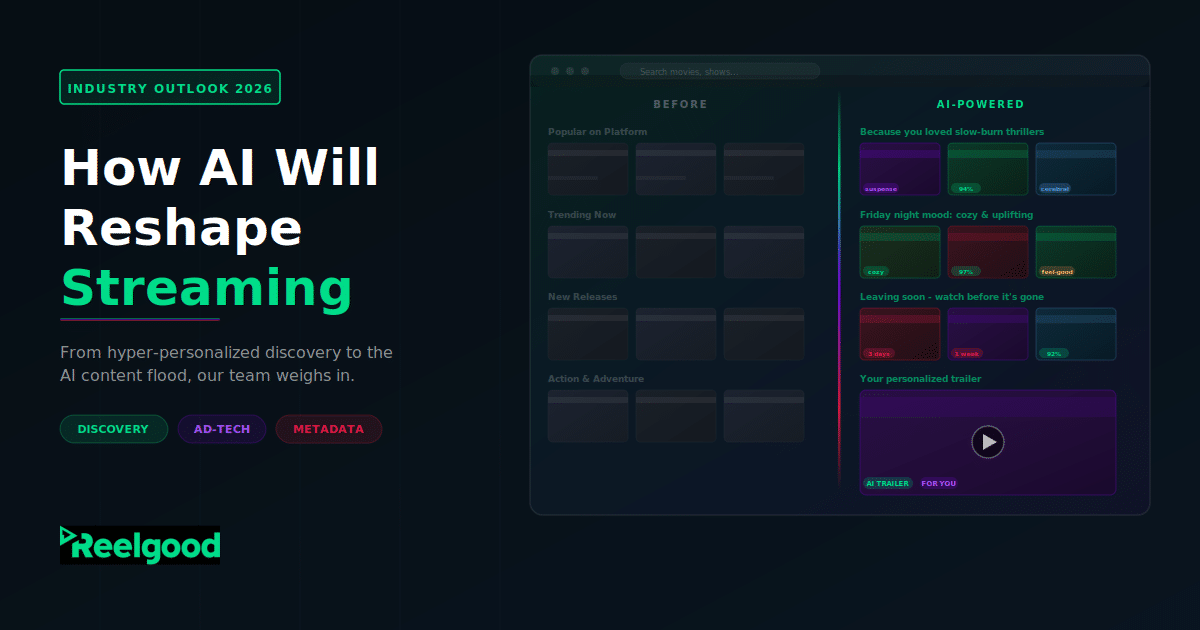
The most consistent theme across the team: AI is about to transform how viewers find what to watch.
The days of scrolling through endless rows of tiles may finally be numbered. According to a Roku study, streaming viewers spent as much as 20 minutes on average to find their next watch in 2025, up from 7.5 minutes in 2019. AI-driven recommendations, Roku predicts, will start to reverse that trend this year.
“On the frontend, I think streaming services will do a much better job presenting their content to users, choosing more wisely the movies and shows that are shown to a user in order to minimize the idle time that a person spends searching for what to watch,” says Diego Suarez, Data Analyst.
“On the backend, entertainment companies will have real-time knowledge of what type of content they need to acquire and dispose of to make their service more appealing specifically for each user. In the aggregate, this knowledge will help them make strategic decisions regarding content acquisition, licensing, and production.”
Daniela Velasco, Lead Data Analyst, sees this shift playing out across both streaming services and the hardware layer. “At the UX level, ML and AI will be used ubiquitously across streaming services and TV operating systems like Roku and Fire TV to drive discovery and hyper-personalization,” she says. “Prime Video is already experimenting with AI-generated trailers. Imagine trailers personalized to each viewer.”
That’s not hypothetical. Amazon launched AI-generated Video Recaps in late 2025, using generative AI to produce theatrical-quality season summaries with narration, dialogue, and music. Industry analysts see personalized trailers as a logical next step from that same underlying technology.
Miguel Callejas, Lead Data Entry Team, puts the impact in retention terms: “With AI, companies can track and understand what users are watching, the whole journey within a platform, how long they are staying, and make on-the-fly decisions on how to avoid a fast bounce rate for users that don’t find anything interesting to watch.”
Andres Fuertes Ruiz, Data Engineer, takes it further, predicting that “AI will dynamically design every interaction, including real-time customization of product recommendations, pricing, and homepages to the individual viewer.”
That level of personalization requires a foundation that many services haven’t built yet: rich, granular, well-structured metadata.
As Damien Capocchi, Backend Engineering Manager on the team, notes, this means “improved recommendations based around broader themes and moods, narrower than genres but deeper than tags.” The recommendation engine is only as smart as the data feeding it.
AI Behind the Curtain: Monetization and Ad-Tech
Personalized discovery gets the headlines, but AI may have an equally significant impact on the business side, where it’s less visible but increasingly essential.
“Behind the scenes, ML and AI will become just as pervasive for monetization, powering more sophisticated ad-tech optimization and targeting,” says Daniela Velasco. As ad-supported tiers become standard across services, the ability to match the right ad to the right viewer at the right moment is a major revenue driver, and that’s a machine learning problem at scale.
The numbers back this up.
Netflix’s ad tier now has 94 million monthly active users worldwide, with more than half of new subscribers in ad-available markets choosing that option.
According to the IAB’s 2025 Digital Video Ad Spend & Strategy report, almost 90% of video advertisers plan to use AI tools to create or optimize video ads by 2026. Netflix itself announced at its 2025 upfront that pause ads and interactive mid-rolls powered by generative AI will roll out across all ad-tier markets this year.
Diego Suarez sees the same convergence from the content acquisition side: when AI can model individual viewer preferences in real time, it doesn’t just improve what someone sees on the home screen. It also informs what a service should license, renew, or let expire.
The same data that powers a better homepage can power smarter business decisions across the content lifecycle.
Making Data LLM-Ready
One insight that cuts beneath the surface-level AI conversation: the data infrastructure itself needs to evolve.
Javier Moran, Engineering Manager, points out that “data needs to be structured in a way that makes it easier and faster for LLMs to find conversational answers.” He references Netflix’s recent shift to a knowledge graph architecture as an industry signal that the biggest players are already restructuring their data layers to be AI-native.
Netflix’s Entertainment Knowledge Graph uses an ontology-driven, RDF-based architecture to unify disparate entertainment datasets, powering everything from recommendation models and content valuation to market intelligence and talent insights. It’s a fundamental shift from flat, siloed databases to interconnected, semantically rich data structures.
This has implications beyond any single service. As conversational search and AI assistants become primary discovery tools, the streaming services and data providers with clean, semantically rich, and well-structured metadata will have a significant advantage.
Those still operating with fragmented data will struggle to surface their content in the places where viewers are increasingly looking for it.
The AI Content Flood (and Why It Could Backfire)
Not all of the team’s predictions are optimistic.
Several members raised concerns about AI-generated content saturating streaming catalogs, and the consequences that follow.
Felipe Lemarie, Data Science Lead, expects to see “more cheaply generated content with AI scripts that will flood the market,” and predicts we’ll eventually “see a full AI streaming service at one point.”
Pablo Lucio Paredes, Head of Engineering and Data, agrees, noting that “the prevalence of AI-generated short- to medium-form content will only make quality human-made productions all the more valuable.”
In his view, AI content doesn’t replace human creativity. It creates a new contrast between mass-produced filler and premium storytelling.
That perspective aligns with recent industry research. A Bain & Company report on AI’s impact on media found that while AI-generated content is flooding platforms, premium human-created content remains the primary driver of consumer engagement.
The report also notes that franchises and established IP give incumbents a significant advantage in this environment, as emotional connections to known creative work aren’t easily replicated by AI.
Meanwhile, the scale of AI-generated video is growing rapidly. According to the Reuters Institute’s Journalism and Technology Trends and Predictions 2026 report, one in ten of the fastest-growing YouTube channels globally now features only AI-generated video content, and an estimated 1 billion AI-generated videos are projected to hit platforms in 2026.
Renato Avilés of the Data Entry Team takes a longer view of AI’s creative trajectory: “AI technology has already had a significant impact in 2024 and 2025, influencing screenwriting and increasing efficiency, sometimes at the expense of originality.”
Looking ahead, he sees AI-powered video creation “evolving into a new viewing medium, similar to anime but emerging from a completely different creative branch.”
The implication: platforms will need to decide whether, and how, to incorporate AI-generated content into their catalogs.
For data and metadata teams, this creates a new challenge.
If AI-generated content floods the market, distinguishing it from human-produced work, and appropriately tagging, classifying, and surfacing it, will become operationally critical.
AI Needs Guardrails
The enthusiasm isn’t unconditional.
Marina Germani, QA and Data Entry Analyst, offers a measured perspective: “I believe AI can be a valuable tool, as long as clear guidelines are provided, including constraints or guardrails to prevent misinterpretation.”
Andrés Granizo, Data Entry Analyst, frames it as a maturity shift: “AI is not a feature anymore. It has become a tool for the streaming sector. The personalization for the user experience will change, but not just for recommendations.”
The novelty phase is over. What matters now is implementation quality.
This aligns with what we’re seeing across the industry. The streaming services that will benefit most from AI in 2026 aren’t the ones making the loudest claims about it. They’re the ones with the underlying data quality, the structured metadata, and the operational workflows to actually deploy it effectively.
What It Means for the Industry
AI is transforming streaming on two fronts simultaneously.
On the consumer side, it’s eliminating friction in discovery and creating viewing experiences that feel individually curated.
On the business side, it’s turning content strategy, ad monetization, and licensing management into real-time, data-driven operations.
But the team’s predictions also carry a warning:
AI without a strong data foundation is just automation of bad decisions.
The streaming services that will pull ahead are those investing in the metadata infrastructure, the taxonomies, the semantic richness, and the data quality that make AI tools actually useful rather than just flashy.
The gap between services that are AI-ready and those that are just AI-curious is about to become very visible.
This post is part of a series on our team’s 2026 streaming industry predictions. Read more: Bold Predictions: What May Shake Up Streaming in 2026 | Metadata as a Strategic Asset: What Separates Leaders from Laggards | Operational Intelligence: Why Streaming Teams Need Faster Answers