Where Was That Title Last Year? Why Historical Streaming Availability Data Is a Strategic Necessity
Key Takeaways
- Historical streaming TV & movie availability data provides the context that licensing teams, rights managers, and analysts need to make informed decisions about content worth hundreds of millions of dollars.
- Without it, organizations risk overpaying for overexposed content, missing compliance violations, misreading viewership trends, and leaving revenue on the table.
- Real-world content licensing patterns, like Universal’s 18-month Peacock-Netflix rotation for animated films or Netflix’s $500M+ global deal for Seinfeld, are only fully visible when you can track title movement across services at daily granularity.
- Reelgood tracks title availability across 300+ streaming services with 99%+ accuracy, updated in real time, with historical data extending back to 2019 for major markets.
In 2023, The Super Mario Bros. Movie grossed $1.36 billion at the global box office. It was a massive hit for Universal and Illumination.
But what happened after theaters is just as interesting from a business perspective, and far harder to track.
The film debuted on Peacock in August 2023, moved to Netflix in December 2023, returned to Peacock in October 2024, shifted to Prime Video in February 2025 under a separate Universal-Amazon output deal, and cycled back to Peacock again in February 2026. Throughout, it remained available as a paid TVOD rental across multiple platforms.
That kind of movement isn’t random.
It follows the structure of Universal’s Pay-One licensing arrangement.
Under the deal announced in July 2021, Illumination and DreamWorks Animation films follow a fixed 18-month rotation: four months exclusively on Peacock, ten on Netflix, then four months back on Peacock. The Reelgood availability data tracks this pattern closely.
But here’s the question:
if you’re a competing streaming service, a content buyer, or an analyst trying to understand the market, how would you know any of this without comprehensive historical availability data?
The answer, for most teams in the industry, is that they wouldn’t.
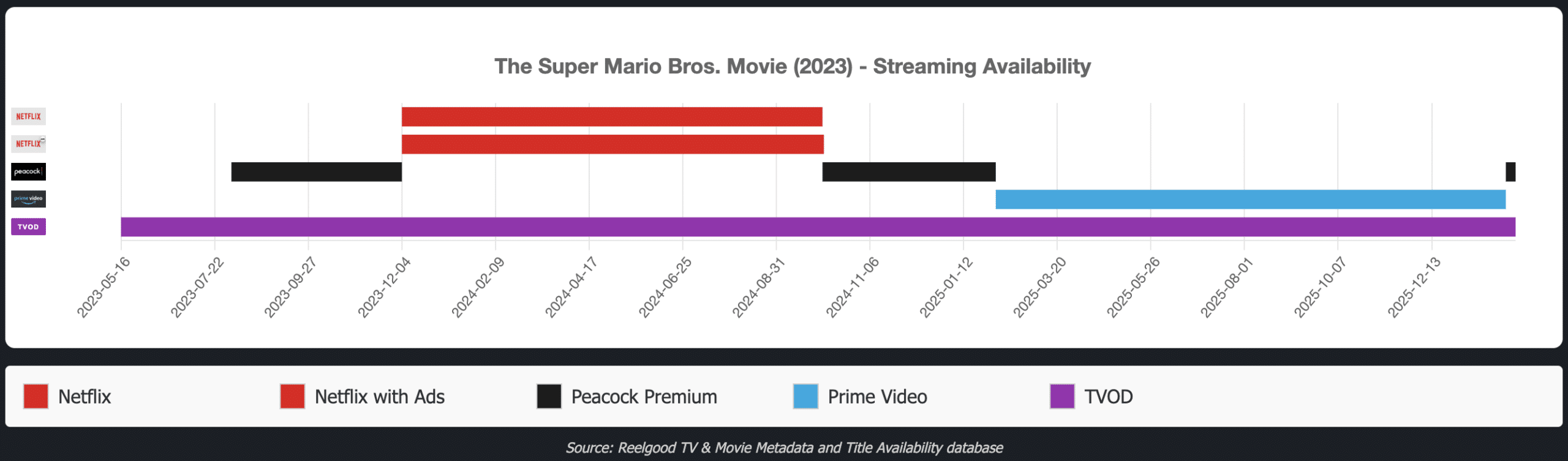
The availability chart above shows the precise cadence of Universal’s output deal in action, with each streaming platform handoff visible at daily granularity. (The chart displays weekly intervals for long-term readability, but the underlying Reelgood data is updated in real time and available at daily resolution.)
The Problem: Licensing Decisions Made in the Dark
Streaming content licensing is a high-stakes business.
Major deals routinely involve hundreds of millions of dollars.
Netflix paid over $500 million for global rights to Seinfeld in a 2019 deal (the show moved to the platform in October 2021), outbidding competitors including HBO Max and Peacock. Before that, Hulu held Seinfeld for six years under a deal reported at $160 million by Variety.
For context, NBCUniversal paid $500 million for domestic streaming rights to The Office, and WarnerMedia secured Friends for $425 million, also domestic-only. Netflix’s advantage with Seinfeld was that its deal covered worldwide rights, which drove up the bid value.
These are enormous sums, and the teams negotiating them need context.
- Where has a title been available?
- For how long?
- On how many services simultaneously?
- Was it exclusive, or was it also running on TVOD while it sat on a subscription platform?
Without historical availability data, these decisions have traditionally been what one content acquisitions executive described as “educated guesses.”
Teams piece together information from trade press reports, internal tracking spreadsheets, and institutional memory. The result is incomplete, inconsistent, and often wrong.
This isn’t a niche problem.
It affects content licensing teams, rights management departments, competitive intelligence groups, financial analysts, and marketing teams across the streaming ecosystem.
And the consequences of getting it wrong range from overpaying for overexposed content to missing compliance violations worth millions in penalties.
Teams across the entertainment industry are already applying this kind of data to a wide range of use cases, from content strategy and licensing to competitive intelligence and deal compliance.
What Historical Title Availability Actually Looks Like
Reelgood tracks streaming title availability across 300+ services at daily granularity, with historical data extending back to 2019 for major markets.
Combined with rich TV & movie metadata (titles, cast, crew, genres, tags, descriptions, and more), that means we can show, with precision, when entertainment content appeared on a given service, when it left, and where it went next.
Take Seinfeld as an example.
The data shows three distinct phases in the show’s streaming life.
Hulu held the rights from June 2015 through June 2021. After a brief window of roughly ten weeks where the show was only available as a paid TVOD rental, Netflix launched it globally on October 1, 2021. That Netflix deal runs through 2026.
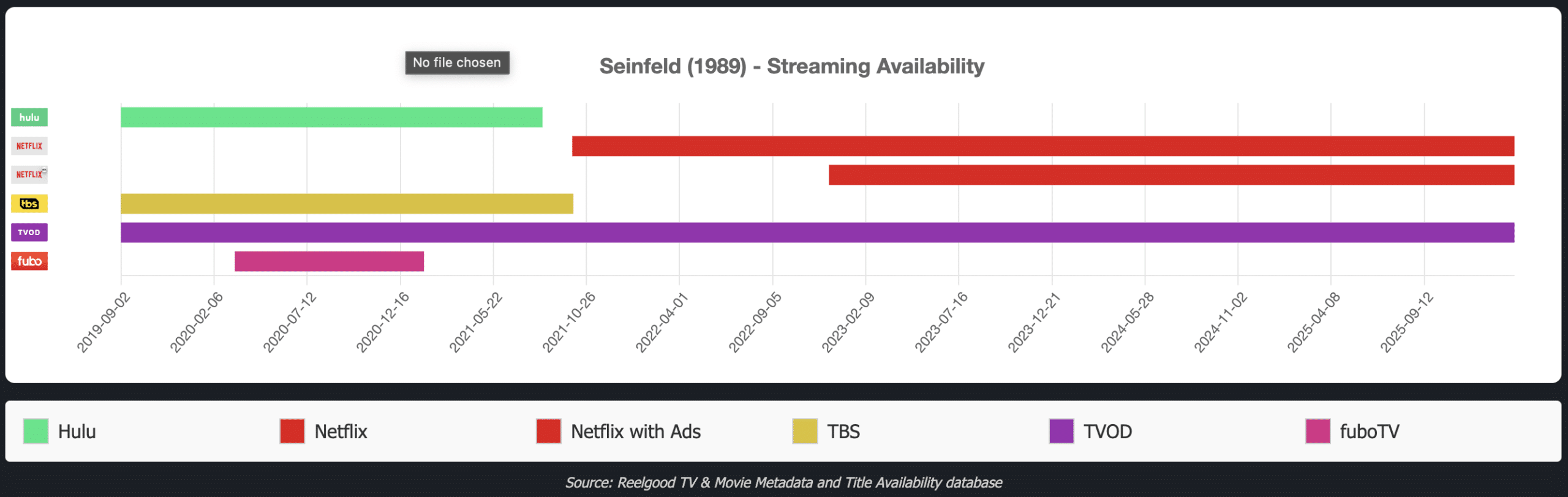
The availability chart for Seinfeld tells a story that no individual trade report captured in full: the transition from Hulu to Netflix, the gap period where only TVOD was available, the staggered launch of the ad-supported Netflix tier, and the consistent TVOD availability running underneath the entire timeline.
For The Super Mario Bros. Movie, the chart reveals the precise cadence of Universal’s output deal in action, with each streaming platform handoff visible at daily resolution. It also shows the Prime Video window that resulted from a separate deal, a detail that only becomes clear when you can see the full timeline across all services.
This level of visibility is what turns anecdotal industry knowledge into actionable intelligence.
Five Ways Teams Use Historical Availability Data
Content Licensing and Acquisitions
When a content buyer evaluates a title for licensing, one of the most important questions is: has this title been overexposed?
If a show has been simultaneously available on three subscription services and multiple TVOD platforms over the past two years, its exclusivity premium should be priced accordingly.
Without historical data to verify this, buyers risk overpaying for content that audiences have already had ample access to.
Historical availability also informs competitive positioning.
If a rival service dropped a title six months ago, that creates a window of audience demand that a well-timed acquisition could capture.
Rights Management and Deal Compliance
Studios and distributors need to verify that their licensing partners are honoring the terms of their deals.
- Is content appearing on time?
- Is it disappearing when it should?
- Are there unauthorized windows where a title is available on a platform that shouldn’t have it?
One major studio uses Reelgood data to monitor third-party FAST channels for unauthorized content, cross-referencing availability against its licensing agreements.
Another uses the data to ensure that titles appear across all contracted distribution points, including platform-specific channels, apps, and cable/satellite feeds, on the agreed schedule.
These aren’t theoretical risks.
Late takedowns, early launches, and unauthorized availability can trigger contractual penalties and damage relationships between licensing partners.
Competitive Intelligence
Understanding how competitors manage their catalogs is essential for strategic planning.
Historical availability data reveals patterns that point-in-time snapshots miss entirely:
- Seasonal licensing strategies,
- Genre-specific buildups and selloffs,
- Windowing experiments, and
- Shifts in catalog composition over time.
For example, tracking when a competitor systematically sheds comedy titles while acquiring dramas might signal a strategic pivot.
Identifying the exact timing of a competitor’s exclusive window on a high-profile title can inform counter-programming decisions.
Performance Analysis and Forecasting
Viewership data without availability context is incomplete.
When a title spikes in Nielsen ratings or platform engagement metrics, the first question should be: did something change about where it’s available?
A show that jumps 40% in viewership the same week it moves from a niche service to a major platform isn’t experiencing organic growth. It’s experiencing distribution-driven demand. Without historical availability data to provide that context, analysts risk misattributing the spike and making flawed forecasts.
Several streaming services blend Reelgood availability data with their internal consumption metrics specifically for this reason, using it as a variable in forecasting models that would otherwise lack critical context about the content lifecycle.
Music Rights and Royalty Collection
This is a use case that often surprises people.
Music rights organizations need to know where TV shows and movies are streaming because the songs in those titles generate royalties based on distribution. Some rights holders have collected payments retroactively going back five or more years after discovering, through historical availability data, that their music was in content streaming on platforms they hadn’t been tracking.
The Cost of Not Having This Data
The risks of operating without accurate, comprehensive historical availability data fall into several categories.
Overpaying in negotiations
Without visibility into a title’s availability history, buyers can’t assess whether content has been widely available or genuinely scarce. This directly affects deal pricing. If content is available everywhere, pricing should reflect that availability.
Missing compliance violations
Content that lingers on a platform past its licensed window, or appears before its contracted start date, represents a breach that can carry financial penalties. Without systematic monitoring against historical baselines, these violations go undetected.
Inaccurate performance analysis
Viewership spikes and drops that correlate with availability changes look very different from organic audience behavior. Teams that can’t overlay availability history with consumption data are working with an incomplete picture.
Flawed competitive strategy
Point-in-time catalog snapshots don’t reveal trends. Without historical depth, competitive intelligence teams miss the patterns that indicate where the market is heading.
Revenue leakage
For rights holders, particularly in music, gaps in availability tracking translate directly to uncollected royalties.
Why Accuracy and Granularity Matter
Not all availability data is created equal.
Some third-party sources offer only monthly or weekly snapshots. Others rely on web scraping that produces error rates as high as 30% for movie data alone.
When the financial decisions informed by this data involve hundreds of millions of dollars, the difference between daily and monthly granularity, or between 70% and 99%+ accuracy, is material.
Reelgood’s four-tiered matching system, combining automated matching, ML-based precision matching, rules-based bulk matching, and manual quality assurance, achieves 99%+ accuracy across major streaming services.
That level of precision means teams can trust the data when making decisions about content worth tens or hundreds of millions of dollars.
Looking Ahead
The streaming market is only getting more complex.
- FAST channels are proliferating.
- International licensing windows are becoming more fragmented.
- Output deals between studios and platforms are creating intricate rotation patterns that span years.
- And the financial stakes continue to rise.
In this environment, historical title availability data isn’t a nice-to-have.
Bottom line, it’s required infrastructure: the kind of foundational dataset that, alongside accurate entertainment metadata, gives licensing teams, rights managers, analysts, and strategists what they need to do their jobs accurately and confidently.
Titles move. Constantly, and often without warning. The question is whether your data moves with them.
Reelgood tracks streaming title availability and entertainment metadata across 300+ services with 99%+ accuracy, updated in real time, with historical data back to 2019. To learn more about how your team can use this data, get in touch.
Source: Reelgood TV & Movie Metadata and Title Availability database