Content Discoverability Isn’t a Recommendation Problem. It’s a Metadata Problem.
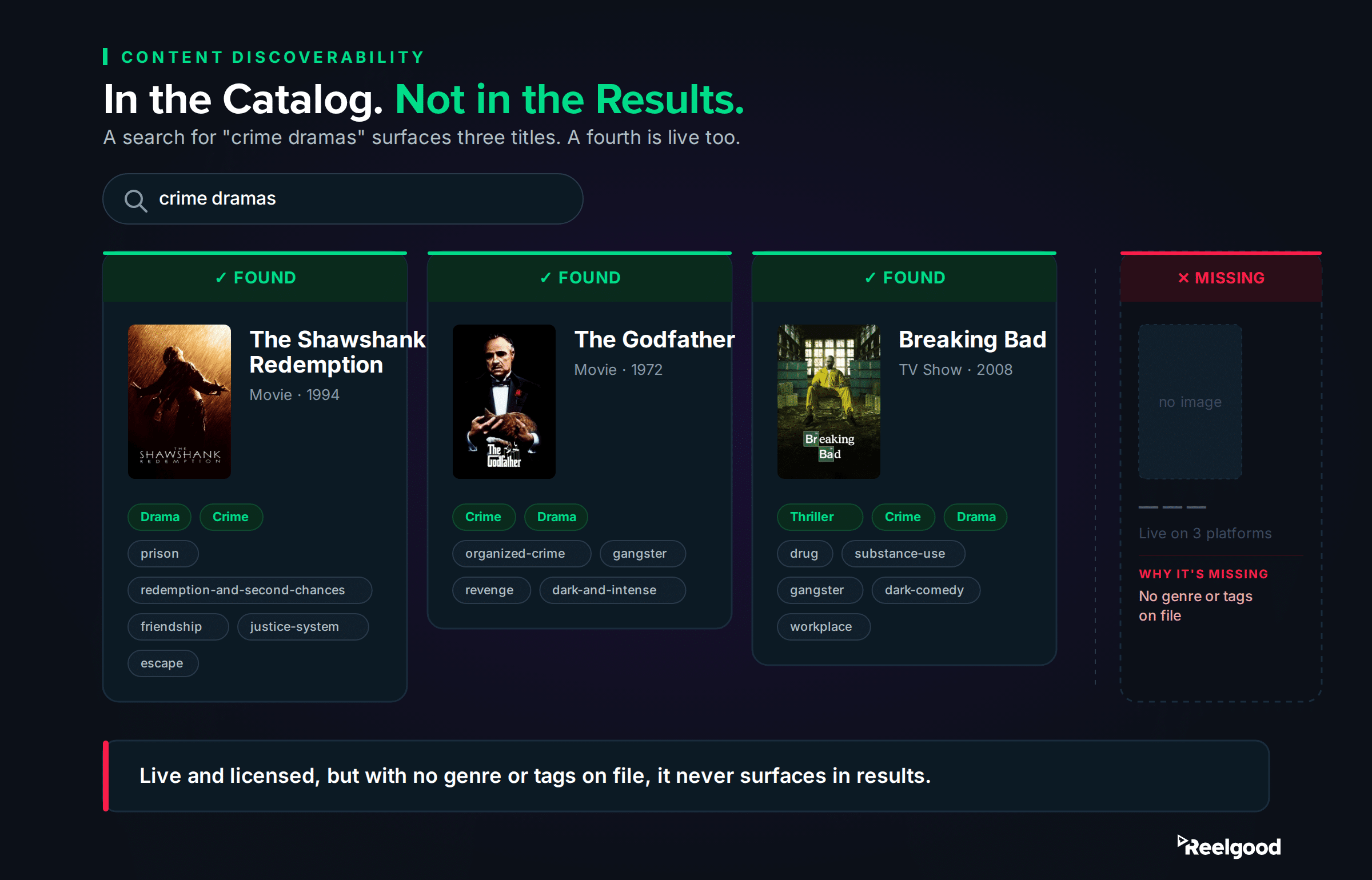
A title being live and a title being findable are decided by two different data layers.
A streaming platform can rebuild its entire browse and recommendation experience and still leave viewers unable to find what they’re looking for. That’s because discoverability isn’t primarily a design problem.
Content discoverability is the degree to which a title that’s licensed and live on a platform actually surfaces in search, browse, or recommendations for the viewers who’d want it,
and that comes down to whether the metadata behind the title is accurate and whether the availability data behind it is current.
Key Takeaways
- Discoverability is decided by the metadata and availability data feeding a platform’s search and recommendation systems, not by the interface built on top of them.
- A title can be live and fully licensed and still be functionally invisible if its metadata is incomplete, duplicated, or missing standard identifiers.
- As FAST and AVOD viewing has grown, metadata quality has become the deciding factor in what actually gets surfaced to viewers, not just what’s technically available.
- Reelgood tracks title availability and metadata across 300+ streaming services globally, covering 290,000+ movies and 74,000+ TV shows, refreshed every few minutes with 99+% ML-verified accuracy.
Why “Available” and “Discoverable” Are Two Different Data Problems
A title going live on a platform and a title showing up in search or recommendations run through different systems, and only one of them is guaranteed by a licensing deal.
Search and recommendation engines match against structured metadata: genre and sub-genre tags, cast and crew, synopsis, and a stable identifier tying a title to everything known about it.
If any of that is missing, wrong, or split across duplicate records, the algorithm has nothing reliable to match against.
The title can be perfectly legal to stream and still never surface.
Duplicate records are a common and underestimated cause.
Two different works can share the same title. An original 2023 film called Barbie is a different work from a 2012 release with the same name, and a metadata provider that keys off title strings instead of stable identifiers, like an EIDR ID, will sometimes merge or split availability data between them.
When that happens, a platform’s catalog can end up with two thin, incomplete entries for what should be one well-populated title, and neither entry carries enough signal for a recommendation engine to surface it with confidence. Reelgood’s taxonomy work, which classifies titles across 250+ tags and six dimensions, exists specifically to give search and discovery systems more to match against than a single genre label.
The same gap shows up on the hardware side.
A smart TV guide pulling from stale availability data will recommend a title that left the platform last week, or fail to surface one that arrived yesterday. Either way, the viewer’s takeaway isn’t “the metadata was out of date.” It’s “this guide doesn’t know what I have access to,” and that’s a discoverability failure with the same root cause as a bad recommendation.
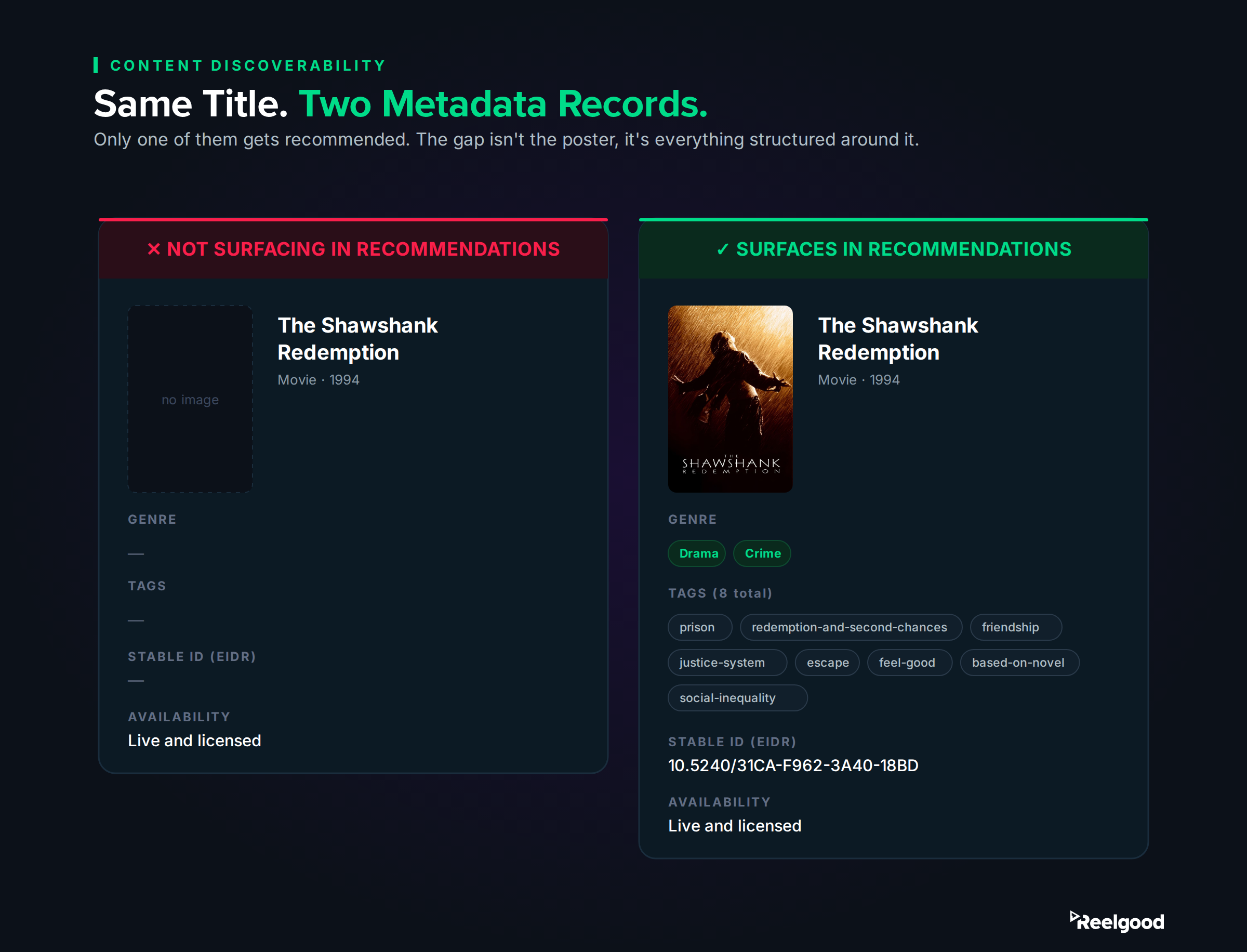
Same title, same availability. Only one metadata record gives a recommendation engine anything to work with.
Metadata Quality Is Deciding What Gets Discovered as FAST Scales
FAST viewing grew 55% year over year, and that growth has made the discoverability problem more acute, not less.
FAST and AVOD catalogs are large, constantly rotating, and often assembled from multiple content suppliers with inconsistent metadata standards. A platform adding hundreds of channels doesn’t automatically gain hundreds of channels’ worth of discoverable content.
It gains discoverable content only for the share of that catalog with clean, matched metadata behind it.
The rest sits in the catalog, technically available and functionally invisible, which is a licensing cost with no corresponding viewership to show for it.
Legacy Metadata Providers Weren’t Built for This Problem
Most of the metadata infrastructure still in use across the industry was built for linear and cable TV, where catalogs were smaller, updated on a schedule measured in weeks, and maintained largely by hand. Legacy providers still carry that architecture: batch updates, manual data entry, and identifier systems that don’t reconcile cleanly against industry standard IDs like EIDR or a platform’s own catalog IDs.
That’s workable for a catalog that changes rarely. But it breaks down for a streaming and FAST environment where availability changes by the hour and catalogs number in the hundreds of thousands of titles, and
It’s usually the platform’s own data or engineering team that inherits the reconciliation work:
cross-referencing IDs by hand, chasing down which of three duplicate records is current, rebuilding a mapping table every time a supplier changes its format.
What Discoverability-Ready Data Actually Requires
Fixing discoverability starts with the same data layer that determines whether a title is technically available: current, accurate availability data covering where a title streams now, where it has streamed historically, and under which business model, paired with metadata clean enough for a search or recommendation system to trust without a verification layer of its own.
Reelgood’s database tracks 300+ streaming services globally, with 290,000+ movies and 74,000+ TV shows, refreshed every few minutes and verified to 99+% accuracy through Reelgood’s ML matching. Every title carries stable industry-standard, cross-system identifiers, so a platform’s own catalog and Reelgood’s data reconcile without manual cleanup on either side.
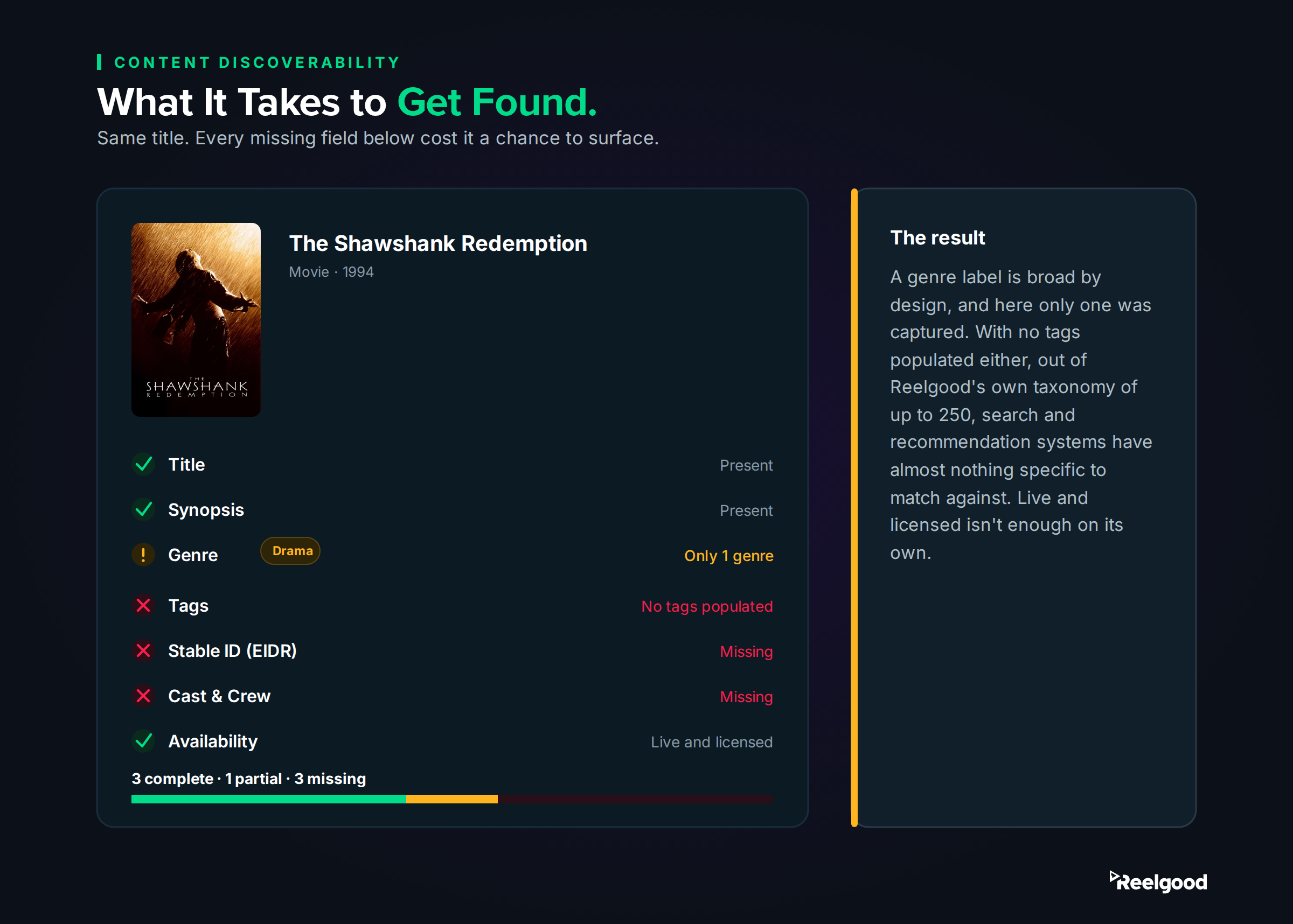
Genre gets a title in the right neighborhood. Tags are what actually make it findable.
Who This Actually Affects
This is a data engineering problem before it’s a design problem. That means it lands on specific teams rather than sitting under a general “product experience” line item.
- Content search and discovery teams building or improving “where to watch” features need availability data current enough to trust in a live search result, not a weekly export.
- ML and data engineering teams building recommendation systems need metadata clean enough to match against reliably, without building their own layer to catch duplicates and mismatches first.
- Product and platform strategy teams deciding where to invest in catalog depth or discovery features need to know which parts of their existing catalog are actually surfacing to viewers today, not just which parts are licensed.
Where to Go From Here
If your team is building or auditing a search, recommendation, or “where to watch” feature, the Reelgood API documentation shows what real-time availability and metadata delivery looks like in practice. If you want to see the underlying schema first, the data dictionary request form is the fastest way to get a sample.
And if your considering or evaluating a switch from a legacy metadata provider, reach out directly and we’ll walk through what a side-by-side comparison looks like against your current catalog.
Data: Reelgood Movie & TV Metadata & Streaming Availability Database, August 2026.