81 HBO Max Movies Are Missing from Prime Video’s Channel. Subscribers Don’t Know.
Key Takeaways
- Reelgood’s tracking of 2,149 HBO Max movies found 81 confirmed titles available on the standalone HBO Max service but absent from the HBO Max add-on channel on Prime Video.
- The gap represents roughly 4% of the full HBO Max movie catalog, and it includes high-demand titles with Reelgood scores above 80: Dune: Part One, Superman (1978), and Moonlight,.
- Catalog discrepancies between a service and its third-party distribution channels are a data quality problem, not a rights problem. The titles are licensed. They’re just not showing up where they should.
- For platforms relying on downstream aggregators or channel partners to reflect their catalog accurately, the risk of silent, undetected gaps is real and measurable.
Subscribers who access HBO Max through Amazon Prime Video are paying for the same service, but they’re not getting the same catalog.
Reelgood’s database currently tracks 2,149 movies available on HBO Max’s standalone service.
But as of March 23, 2026, 81 of those titles — roughly 4% of the entire movie catalog — do not appear in the HBO Max add-on channel on Prime Video.
The films are there on HBO Max. They’re just invisible to subscribers who access HBO through Amazon’s interface.
This isn’t a case of a few deep-catalog titles falling through the cracks.
The missing films include Dune: Part One, which carries a Reelgood score, a mix of quality based on external ratings and popularity, of 92.1 (our demand-weighted rating that reflects how often real viewers search for and watch a title).
Superman (1978) (85.8), Moonlight (84.6), are also absent. Six of the 81 missing titles have Reelgood scores above 80, placing them in the top tier of what HBO Max subscribers are most likely to want.
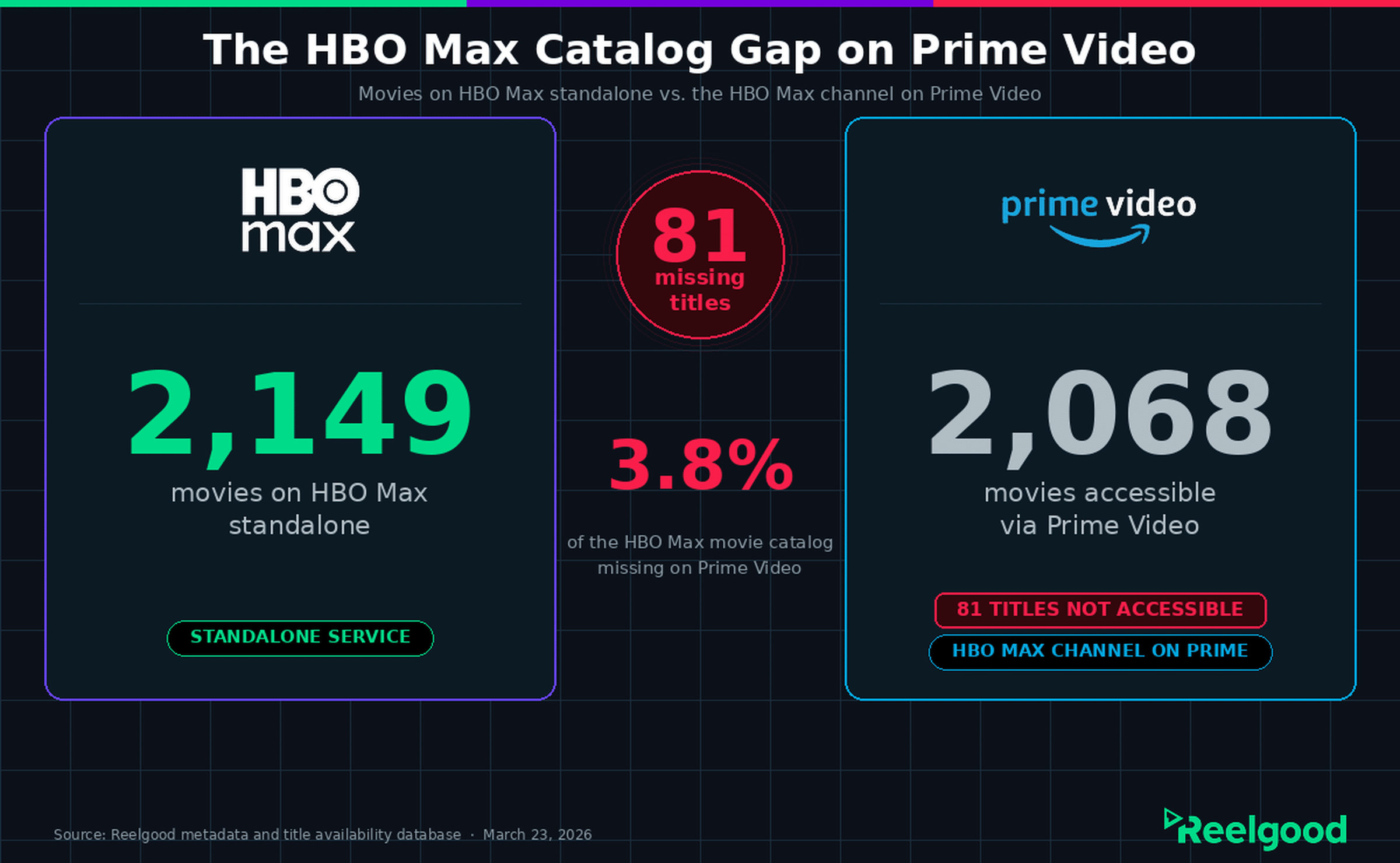
The HBO Max Availability Gap on Prime Video
The underlying issue is catalog data accuracy at the distribution layer.
When a premium channel is delivered through a third-party platform, that platform’s systems are responsible for reflecting the content accurately. The failure point is usually earlier than it looks.
Before a title can even appear in a partner’s interface, it has to be correctly matched — the rights holder’s catalog entry has to be recognized as the same title in the distributor’s system. The problem? There is no industry-standard identifier that makes this automatic.
Studios, platforms, and distributors all maintain their own internal IDs, and mapping between them requires either manual work or a matching system sophisticated enough to reconcile inconsistent metadata across sources (what Reelgood provides!).When that matching breaks down — or never happens correctly in the first place — the result is exactly what we’re seeing: a subscriber-facing catalog that doesn’t match what the rights holder has licensed.
This isn’t a niche concern.
Tens of millions of U.S. subscribers access premium channels through Prime Video rather than through standalone apps. A 4% catalog gap, compounded across a large subscriber base, represents a meaningful volume of content that viewers are paying for and cannot find.
Many won’t know they’re missing it. They’ll search, come up empty, and assume the title isn’t available – or isn’t included in their subscription.
For HBO Max and Warner Bros. Discovery, the downstream reputational effect is real, even though the problem originates in a distribution partner’s systems.
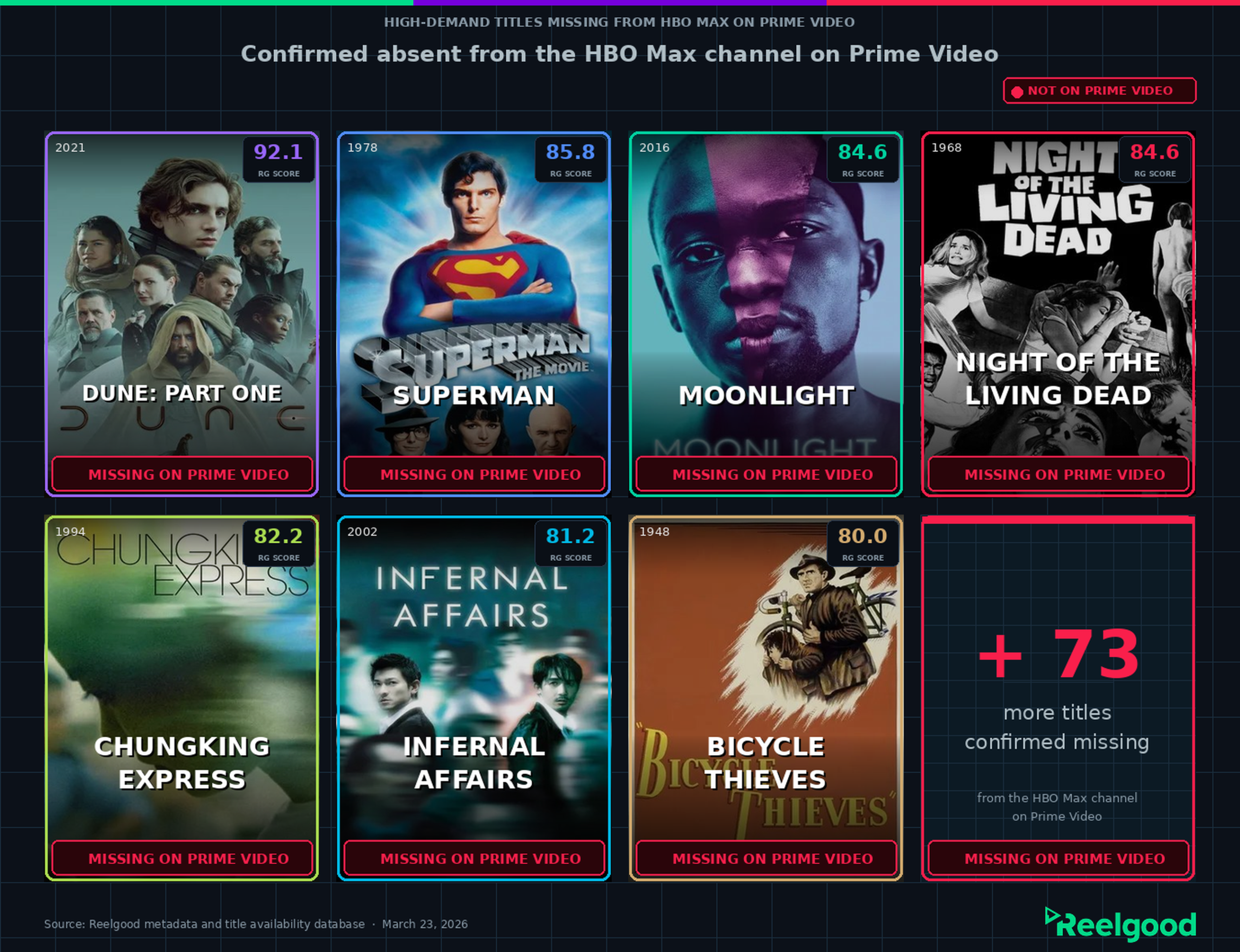
Missing films on Prime Video
No Standard ID. No Automatic Match.
The reason these gaps are hard to catch is structural.
There is no universal identifier for film and TV titles — no equivalent of an ISBN that every platform, studio, and distributor agrees on. When HBO Max licenses a title and delivers it to Amazon, both sides are working from their own internal systems. Correctly connecting those records requires title matching: recognizing that what one system calls “Dune: Part One (2021, Warner Bros.)” is the same asset another system has cataloged differently.
That matching problem is harder than it sounds. Titles have variant names, multiple release versions, regional differences, and inconsistent metadata across sources. Done manually it doesn’t scale. Done poorly it produces exactly the kind of silent gap we documented here — a title that’s licensed, delivered, and contractually present, but functionally invisible to subscribers.
Reelgood’s ML matching engine is built specifically for this problem.
We maintain a unified title database across 300+ streaming services and channels, continuously reconciling records across sources without relying on any single platform’s internal IDs. That’s what makes it possible to run the comparison shown here — and to surface discrepancies between what a rights holder has licensed and what a distribution partner is actually showing subscribers.
As we’ve covered in our analysis of streaming catalog measurement gaps, internal data alone doesn’t tell you what a subscriber actually sees. The delta between what’s licensed and what’s live is where the real quality problem lives — and you can only see it from the outside.
What Platforms and Rights Holders Should Be Asking
For content licensing and rights management teams at studios, networks, and streaming platforms, the question is simple: do you have a reliable, real-time view of whether your licensed content is actually available to subscribers across every distribution channel? Not what your agreements say should be there — what’s actually showing up?
Reelgood’s streaming availability data gives rights holders and platform operators exactly that view: title-level, channel-level, geography-level availability tracking, updated continuously, against the full landscape of where content is supposed to be distributed.
If your team is evaluating catalog accuracy across distribution channels, or if you’d like to see how your content appears in our database, reach out at sales@reelgood.com or request a data sample at data.reelgood.com.
Data: Reelgood Movie & TV Metadata & Streaming Availability Database, March 23, 2026. Analysis covers 2,149 HBO Max movies tracked across the standalone Max service and the HBO Max add-on channel on Amazon Prime Video. Reelgood scores are demand-weighted ratings reflecting viewer search and engagement behavior across Reelgood’s consumer platform.