By the Numbers: What a Combined Paramount-WBD Content Library Actually Looks Like
Key Takeaways
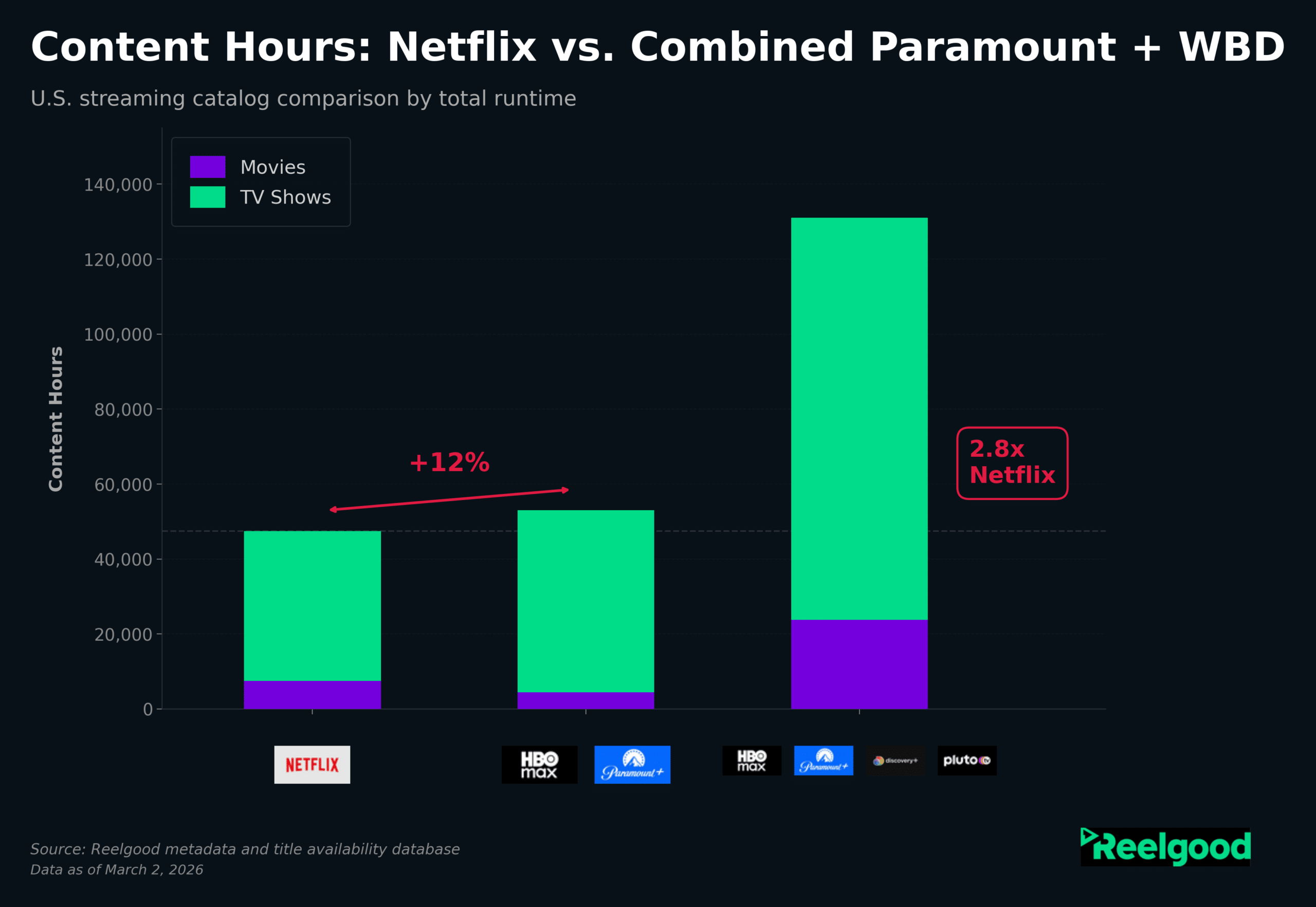
- A combined HBO Max + Paramount+ catalog would deliver ~53,000 content hours, 12% more than Netflix’s ~47,500, before a single new title is produced.
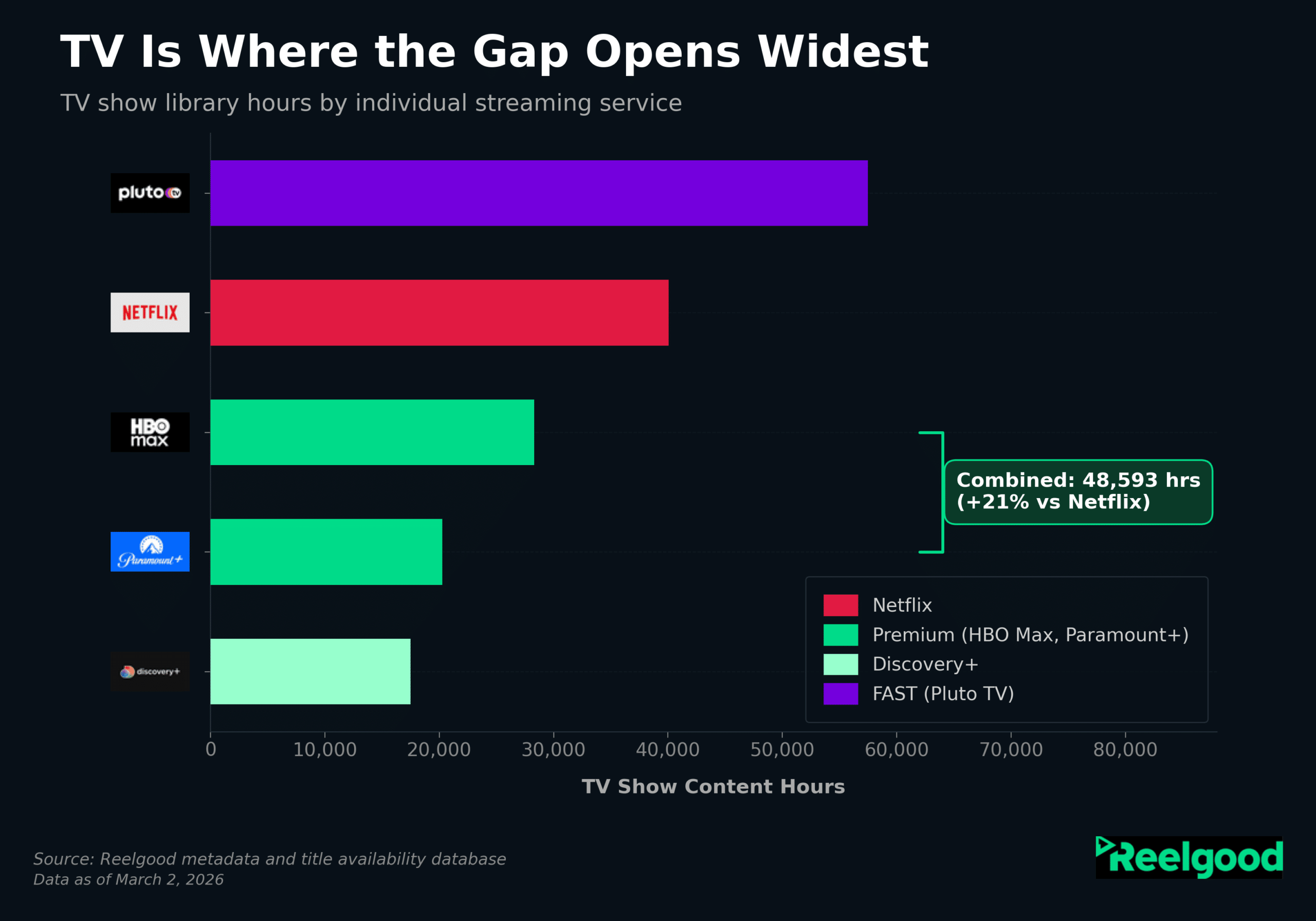
- TV libraries are the difference maker. The two services together carry ~48,600 hours of TV content vs. Netflix’s ~40,100, a 21% edge driven by decades of output from HBO, CBS, Showtime, and other legacy networks.
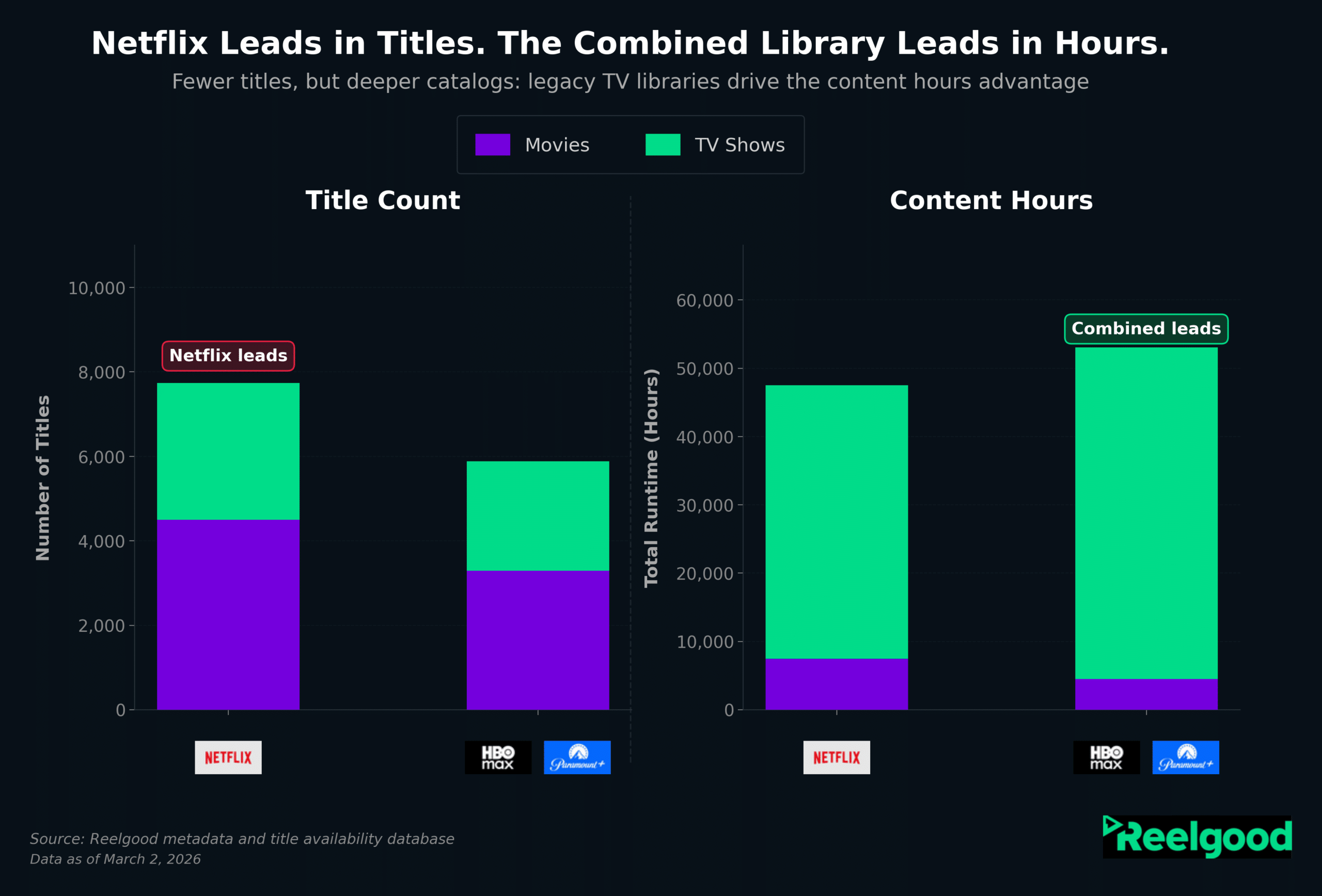
- Netflix leads in raw title count (~7,700 vs. ~5,900), but by watchable depth the picture inverts. The combined catalog skews toward longer-running, multi-season series with more hours per title.
- Add Discovery+ and Pluto TV, and the full Paramount-WBD portfolio reaches ~131,000 content hours, nearly 2.8x Netflix.
When Paramount CEO David Ellison took to a conference call with Wall Street analysts on Monday to lay out his vision for the company’s $111 billion acquisition of Warner Bros. Discovery, a central claim stood out:
The combined entity would have the scale to compete with Netflix.
It’s a bold statement.
Netflix ended 2025 with 325 million global subscribers.
Ellison pointed to a combined 200 million direct-to-consumer subscribers across Paramount+ and HBO. Even setting aside the overlap between those subscriber bases (which Ellison’s figure doesn’t account for), the gap in reach is significant.
But subscriber counts are only part of the competitive equation. What about the content itself?
We pulled current catalog data from Reelgood’s streaming database to see how the content libraries of these services actually compare today, before any merger integration begins.
The results suggest that Ellison’s confidence about scale may be better supported by what’s on the shelves than what’s on the balance sheet.
The headline: Combined content hours already exceed Netflix
The most revealing metric isn’t title count. It’s content hours, which captures the actual depth and watchability of a catalog, giving more weight to multi-season TV libraries and long-form content than a simple tally of titles.
As of March 2, 2026, Netflix’s U.S. catalog totals approximately 47,500 content hours across movies and TV shows.
Combine just HBO Max and Paramount+, the two premium subscription services that would sit at the core of any merged streaming product, and the total reaches roughly 53,000 content hours.
That’s roughly 12% more content than Netflix, measured by runtime. And that’s before adding Discovery+ and Pluto TV.
Include the full portfolio of services under the combined Paramount-WBD umbrella (HBO Max, Paramount+, Discovery+, and Pluto TV) and the number climbs to more than 131,000 content hours, nearly 2.8 times what Netflix offers in the U.S. today.
TV is where the gap opens widest
The advantage is concentrated in television. HBO Max and Paramount+ together account for roughly 48,600 hours of TV content, compared to Netflix’s approximately 40,100 hours, a 21% edge.
That shouldn’t be surprising.
HBO Max carries deep libraries from HBO, Warner Bros. Television, and a range of legacy cable networks. Paramount+ draws from CBS, Showtime, MTV, Nickelodeon, BET, and the broader ViacomCBS archive.
These are some of the most prolific content producers in television history, and their back catalogs reflect decades of output.
Netflix, for all its investment in original programming, is still a relatively young studio. Its library skews toward newer titles and licensed content that rotates in and out of availability. The legacy players carry libraries that, by nature, don’t expire.
In movies, Netflix still holds a lead.
Its catalog includes roughly 7,400 hours of film content, compared to about 4,500 hours for the HBO Max and Paramount+ combination. But movies make up a comparatively small share of overall streaming hours on any platform, and the combined entity’s TV advantage more than compensates.
Title count: Netflix leads, but the story is more nuanced
By raw title count, Netflix maintains an edge at the premium tier.
Its U.S. catalog includes approximately 4,500 movies and 3,200 TV shows, for a total of roughly 7,700 titles. HBO Max and Paramount+ together carry about 3,300 movies and 2,600 shows, approximately 5,900 titles total.
Netflix has more individual titles, but fewer total hours.
What does that tell us?
The combined Paramount-WBD premium catalog skews toward longer-running series and deeper libraries. In practical terms, that translates to more content per title, more seasons to binge, and more hours of engagement per subscriber session.
This aligns with findings from our recent analysis of TV catalog depth across major streamers, which showed that Paramount+ and HBO Max carry significantly higher concentrations of multi-season series than streaming-native platforms.
Paramount+ leads all platforms with 21% of its TV shows running five or more seasons. HBO Max is close behind with 14% of shows at five-plus seasons. Netflix, by contrast, has a catalog where the vast majority of series run only one to two seasons.
The full portfolio is massive, but integration is the question
The numbers become dramatically larger when you factor in Discovery+ and Pluto TV.
Discovery+ adds roughly 17,500 hours of TV content, heavily weighted toward unscripted and documentary programming.
Pluto TV, the free ad-supported service, contributes more than 77,000 hours across movies and TV.
In total, the four services under the combined entity carry approximately 17,700 movies and 6,700 TV shows, more than double Netflix’s title count in both categories.
Of course, raw catalog size doesn’t automatically translate to competitive advantage.
Pluto TV serves a fundamentally different audience and business model than HBO Max. Discovery+’s unscripted library has limited overlap with Paramount+’s entertainment and news programming.
And as Ellison acknowledged on the call, the plan is to consolidate these into a unified platform “over the coming years,” not overnight.
The integration challenge is real.
As industry observers have noted, AT&T’s experience after acquiring Time Warner demonstrated that combining content assets with a streaming strategy is easier said than done, particularly when legacy linear distribution agreements are involved.
What the data suggests for the competitive landscape
None of this is to say the combined Paramount-WBD will immediately rival Netflix’s market position.
Netflix’s advantages in global reach, recommendation technology, and original content investment are well established. And Ellison’s cited subscriber figure of 200 million comes with significant caveats around de-duplication and international overlap.
But the catalog data tells a story that’s often overlooked in the subscriber-count fixation of streaming industry coverage.
In terms of pure content depth, the building blocks are already there.
A merged premium service combining HBO Max and Paramount+ would offer more watchable hours than Netflix does today.
Layer in the broader portfolio, and the content gap isn’t just closed. It’s inverted.
The question isn’t whether Paramount-WBD will have enough content to compete.
The data shows it will.
The question is whether the company can build the technology, user experience, and global distribution to turn that library into a product that keeps subscribers engaged, which is exactly the bet Ellison is making.
Catalog data sourced from Reelgood’s streaming title availability database, snapshot taken March 2, 2026. Title counts and content hours reflect U.S. availability and may include overlap where titles appear on multiple services within the combined portfolio.
To explore how Reelgood tracks content availability, catalog composition, and competitive intelligence across 300+ streaming services in 20+ countries, visit data.reelgood.com.