From Music Royalty Tracking to Editorial Discovery: How Reelgood Customers Are Putting Streaming Data to Work
Next in our series on the Reelgood team’s 2026 Streaming Industry Predictions.
Key Takeaways
- The most impactful customer use cases for Reelgood’s metadata and availability data span far beyond consumer discovery: a sync licensing company uses it to calculate and reclaim owed music royalties, while a major editorial publisher uses it to power embedded “where to watch” experiences for millions of readers.
- Customers consistently treat availability changes as a real-time competitive signal, monitoring competitor catalogs to spot acquisition opportunities the moment a popular title leaves a rival service.
- For aggregators, search engines, AI companies and tech platforms, unified availability data acts as a “front door” to a fragmented streaming web, helping users navigate hundreds of services with a single query.
- The common thread across every use case: customers don’t buy streaming data. They buy a continuously verified, normalized view of a landscape that no single service can map on its own.
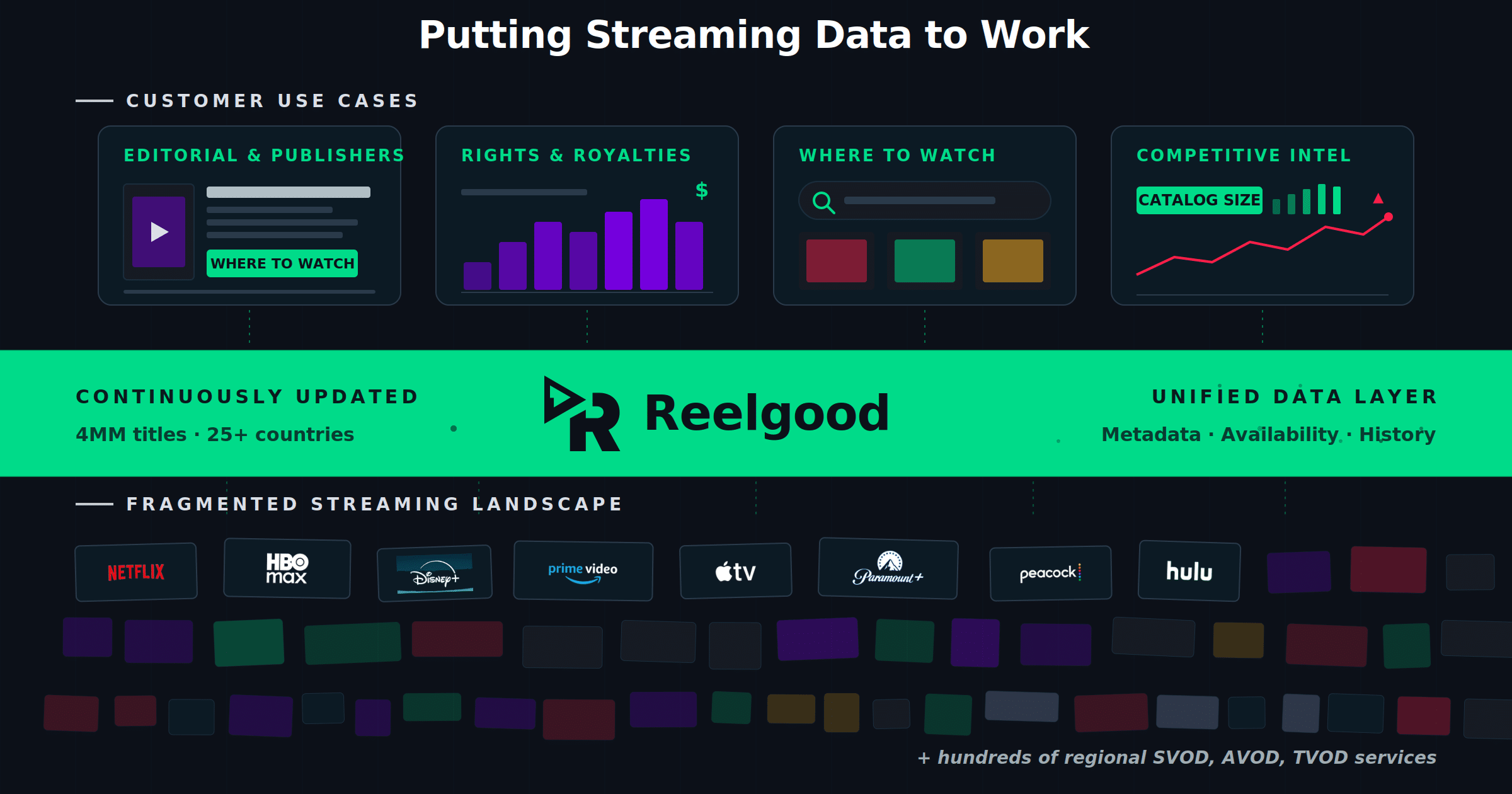 Most conversations about streaming data start with the obvious use cases: building a recommendation engine, powering a content guide, monitoring a competitor’s catalog. Those are real, and they matter.
But when I ask the Reelgood team which customer use cases have surprised them most, the answers tend to be more interesting than that.
They describe businesses that look nothing like a streaming service using availability and metadata to do things the legacy data vendors weren’t designed to support: tracking music royalties across thousands of TV episodes. Embedding live streaming guidance into editorial pages. Spotting the precise moment a competitor’s exclusive becomes acquirable.
The pattern across these stories says something useful about where the value of streaming data is actually concentrated in 2026.
Here are five of the most impactful examples our team flagged.
Tracking Music Royalties Across Thousands of TV Episodes
The use case that surprised me most came from Daniela Velasco, Reelgood’s Lead Data Analyst. It involves a sync licensing company using streaming availability data to recover music royalties owed to the artists in its catalog.
The customer is Crucial Music, an independent music licensing company that places tracks from a catalog of more than 17,000 songs into film, television, and advertising. According to a Trolley case study profiling the company, Crucial Music has licensed music to Oscar-winning films like Gravity and Captain Phillips, and to television productions including Pam & Tommy, How I Met Your Father, and Grace and Frankie.
What’s hard about this business is the back end.
When a song is placed in a TV show, the artist is owed royalties every time that show is distributed: theatrical, broadcast, streaming. Calculating what’s owed depends on knowing exactly where the show is available, and for how long, across every platform and territory. That visibility is precisely what fragmented streaming has made difficult to assemble.
“Crucial Music uses our title availability data alongside their own music data to identify where their music appears across streaming catalogs and for how long,” Daniela explains. “That time-based visibility allows them to accurately calculate owed royalties and determine exactly which parties to reclaim revenue from.”
The structural insight here matters beyond music.
Any rights holder whose revenue depends on knowing where a piece of intellectual property is currently distributed faces some version of the same problem:
production companies tracking residuals, talent agencies monitoring image-rights compliance, sports leagues auditing licensed footage. The fragmented streaming landscape made all of those workflows harder.
A continuously updated availability layer, especially one with historical data on when titles arrived and left platforms, gives those teams the foundation to do their jobs at scale.
Powering Editorial Discovery for Publishers
A second category of use case sits closer to the consumer surface: publishers and editorial platforms using availability data to turn an article about a movie or show into a one-click path to watching it.
Diego Suarez, Data Analyst, points specifically to Decider, the streaming-focused editorial property launched by News Corp’s New York Post. Decider has integrated Reelgood’s title availability data into its reviews and recommendations since 2019, surfacing every SVOD, AVOD, and transactional platform where a referenced title can be watched, with direct links.
“For availability, the use case of Decider comes to mind,” Diego says. “They integrate our data to offer their readers a chance to stream the content they mention on their publications right there on their site.”
The reader benefit is obvious: no jumping between Google, the streaming service, and the article to figure out where to watch Severance. The publisher benefit is less obvious but equally important.
Embedded availability turns an editorial page from a recommendation into a transaction,
which has measurable downstream effects on time-on-page, return visits, and affiliate revenue.
Diego notes the broader opportunity: “There are hundreds of publications on the streaming industry that can benefit from our availability data.” For metadata specifically, he adds, the most impactful customers are “companies that want to power their own platforms of the streaming industry using our data” — which extends beyond editorial to smart TV operating systems, voice assistants, and search engines.
Spotting Catalog Gaps the Moment They Open
A third category sits squarely in the world of competitive intelligence, but with a more tactical edge than the licensing-strategy use cases I see most often.
Liseth Mina Rosero, Data Entry Specialist and QA, frames it this way: “Customers benefit by spotting content gaps fast, like when a popular title leaves a competitor’s catalog and they can jump in to promote something similar or license it themselves.”
This is operational competitive intelligence rather than strategic analysis. The use case isn’t quarterly catalog audits. It’s the ability to detect, within hours, that a tentpole title has dropped off Hulu and to act on that information before subscribers notice the gap.
We see this pattern reflected in the catalog change tracking that Reelgood publishes on our own marketing pages: in any given window, high-value movies leave the major SVOD platforms entirely and end up unavailable across the big six streamers.
For licensing teams, those are direct acquisition opportunities. For marketing teams, they’re cues to surface in-catalog substitutes before churn risk materializes.
Liseth also points to the metadata side of this work: “Smarter content tags going beyond genre, surfacing titles based on mood, theme, or vibe, really help hidden gems get noticed.” That ties directly to the emotional metadata gap we covered in the Measurement Gap post — and it’s the same data layer that lets editorial and product teams build merchandising rows that aren’t just “Action Movies” for the seventh time.
The “Front Door” Function: Navigating a Fragmented Open Web
A fourth use case is more abstract but increasingly important: acting as the unified availability layer that lets users find content across hundreds of services from a single starting point.
Andres Fuertes Ruiz, Data Engineer, captures it concisely: “Unified availability data allows platforms to act as a front door for the open web, guiding users to the right service across fragmented global catalogs.”
This is the use case behind every “where to watch” feature embedded in a smart TV, search engine, voice assistant, or aggregator app. Each of those products solves the same user problem from a different surface: the consumer doesn’t know which service has the title they want, and they don’t want to check seven apps to find out.
The scale of the underlying fragmentation makes the case for itself. According to Comscore’s 2025 State of Streaming report, the average U.S. household now streams content from 6.9 services.
No single service can represent that footprint accurately on its own. The platforms that can represent it reliably become the default starting point for discovery, which is a position with substantial strategic and economic value.
Miguel Callejas, Lead on the Data Entry Team, frames the same use case from the consumer’s side:
Customers benefit when “they don’t need to jump from one service to another to find what they’re looking for, with recommendations based on their preferences and new releases available as soon as they come out on any service.”
For consumer tech companies, AI enterprises and aggregators, the opportunity isn’t just helping users find a title. It’s becoming the layer that routes attention across the streaming ecosystem — and capturing the value that comes with that position.
Data Freshness as the Foundation Underneath All of It
The thread connecting every use case above is one our team came back to repeatedly: the speed and reliability with which availability data is updated.
Andrés Granizo, QA and Data Entry Analyst, puts it simply: “How quickly we can have the data updated, when a title becomes available. That’s because we can react as fast as possible when it’s needed.”
Marina Germani, QA and Data Entry Analyst, names the same dynamic from a slightly different angle: “The most valuable info is getting alerts for new titles or episodes, so you know as soon as they’re available on your platforms.”
Renato Avilés, Data Analyst, ties it to data quality, which is a related but distinct point:
“Our clients primarily benefit from up-to-date, verified information, where data quality has become a top priority. Reviewed and reliable data allows us to provide accurate, real-time content availability across platforms, making it easier for users to find where to watch each title with confidence.”
Carolina Tinajero, Data Entry Analyst, adds the geographic dimension: customers consistently care about availability of titles per location, which becomes more important as services build region-specific strategies and adjust catalogs to local market conditions.
None of these team members are describing a sexy product feature. They’re describing the unglamorous infrastructure underneath every other use case in this post. Royalty tracking, editorial integrations, competitive monitoring, and “front door” experiences all collapse if the data feeding them is stale, inconsistent, or misaligned across regions.
Customer trust in a data partner is built on getting the boring parts right, repeatedly, at scale.
What These Use Cases Have in Common
The use cases above span different industries and serve different functions. They include a 17,000-song music catalog, a publisher with millions of monthly readers, licensing teams at major streaming services, and aggregators serving consumers across the open web.
What every one of them shares is a structural problem that streaming fragmentation has made worse: the data needed to run their business is generated by hundreds of different services that don’t share a common schema, a common ID system, or a common update cadence.
That’s the problem Reelgood was built to solve.
The customers we hear from with the most impactful stories aren’t using us as a recommendation engine or a marketing dashboard.
They’re using us as the canonicalized, continuously updated layer between their business and a streaming landscape that resists being measured.
For a music licensing company, that translates into recovered royalty revenue. For a publisher, it translates into reader engagement and affiliate value. For a streaming service, it translates into catalog decisions that don’t lag the market.
The streaming data conversation in 2026 has moved past whether companies need this layer. The question now is what they’re going to do with it.
For licensing and rights teams: If you’re tracking residuals, sync royalties, or contract compliance against fragmented streaming distribution, Reelgood’s historical availability data gives you the time-based view those workflows require.
For publishers and consumer tech platforms: Our Partner API and S3 exports power “where to watch” experiences across editorial sites, smart TVs, search, AI companies and aggregators worldwide.
For content acquisition and competitive intelligence teams: Our streaming use cases page walks through how leading services use Reelgood data to monitor competitor catalogs and spot acquisition opportunities the moment they open.
To see how Reelgood data could fit your team’s specific use case, get in touch at sales@reelgood.com.
This post is part of a series on our team’s 2026 streaming industry predictions. Read more: Metadata as a Strategic Asset: What Separates Leaders from Laggards | Operational Intelligence: Why Streaming Teams Need Faster Answers | How AI and Machine Learning Will Reshape Streaming in 2026 | The Measurement Gap: What Most Streaming Services Are Still Missing
Data: Reelgood Movie & TV Metadata & Streaming Availability Database, January 2026.