Reelgood’s Expanded Content Taxonomy: 250+ Tags, Six Dimensions, and What It Means for Streaming Discovery
We’ve overhauled the tag system across 288,806 movies and 72,011 TV shows. Here’s what changed, why it matters, and what you can build with it.
Key Takeaways
- Reelgood has expanded its content taxonomy to 250+ tags across 288,806 movies and 72,011 TV shows, more than doubling the average number of tags per title from roughly 3-4 to 6.
- The new taxonomy is built around six content dimensions: plot and premise, personas and roles, primary setting, themes and issues, tone and vibe, and format and structure.
- No existing genres or tags have been removed. Teams currently using Reelgood’s taxonomy data can adopt the new tags at their own pace, with no disruption to existing workflows.
- Each tag assignment clears a vetting process that analyzes relevancy, and titles are capped at 10-12 tags. More tags per title doesn’t mean less precise tags.
- For teams building recommendation systems, content discovery features, or ad-targeting workflows, the expanded taxonomy provides a meaningfully richer signal per title.
Most content metadata tells you what a title is. Genre: drama. Subgenre: legal. Running time: 47 minutes. That’s useful for organization. It’s not particularly useful for discovery.
What actually helps a viewer find the next thing they want to watch, or helps a product team build a system that surfaces it, is metadata that captures how a title feels, who it’s about, where it’s set, and what it’s really exploring. Metadata that reflects the actual content experience, not just its administrative category.
That’s the problem Reelgood’s expanded taxonomy is designed to solve. Across our ever growing library of 288,806 movies and 72,011 TV shows, we’ve expanded from roughly 100 tags to more than 250, introduced four new genres, and refined how tags are assigned. The average title now carries around six tags, up from three or four previously.
More importantly, those tags improve precision by better capturing what each movie or show is about, rather than relying on broader or less descriptive labels.
Why Most Content Taxonomy Systems Fall Short
Reelgood’s original taxonomy was built on about 100 tags, developed largely by consolidating source-provided tags from individual streaming platforms, into broader categories that work consistently across titles and sources. It worked well enough for basic classification. But it had structural blind spots.
Tags were assigned when a clear mapping existed; when one didn’t, some titles ended up with tags that were less precise and didn’t fully reflect what the content was really about.
A show like The Office might have had child-level workplace tags on individual platforms, but without a matching parent category in our system, that core characteristic went unrepresented.
This is a widespread problem in streaming metadata, not specific to Reelgood’s original system.
As we noted in Metadata as a Strategic Asset, the gap between what platforms have in their catalogs and what their systems can accurately classify and surface is one of the most consequential blind spots in streaming today. Taxonomy depth is where that gap either closes or widens.
The expansion fixes this blind spot with a broader, carefully curated tag set that better captures what each title is really about.. And the before/after difference is significant.
A Framework Built Around Six Content Dimensions
The new taxonomy isn’t just more tags. It’s tags built around six distinct dimensions of what makes a title what it is.
Plot and premise captures the engine that drives the story: the heist, the time loop, the manhunt, the courtroom battle. This is what the show is about in the most immediate sense.
Personas and roles identifies the archetypes at the center of the narrative: the detective, the doctor, the teacher, the antihero. These tags let recommendation systems surface content around the types of characters viewers connect with.
Primary setting and world anchors the story geographically and contextually: the workplace, the small town, the big city, the fantasy realm. Setting shapes tone and expectation in ways genre alone doesn’t capture.
Themes and issues goes deeper into the subject matter a title is genuinely engaging with: addiction, class inequality, grief, corruption, identity. These tags power thematic discovery and give ad-targeting teams meaningful signals for brand suitability.
Tone and vibe is the affective layer: witty, dark and intense, feel-good, quirky and offbeat. For recommendation systems and mood-based discovery features, tone is often the most predictive signal for viewer satisfaction.
Format and structure covers how the story is told: mockumentary, anthology, found footage, limited series. Format signals inform viewer expectations before they hit play.
Together, these six dimensions give every title a richer, more complete profile than genre alone provides.
A drama can be a workplace drama that’s tonally dark, structured as an anthology, and centered on themes of corruption. The old taxonomy might have captured “drama” and one or two tags. Our expanded taxonomy captures all of it, giving our data users more information to work with.
Taxonomy in Practice: Before and After
The shifts are most visible on titles with complex, layered content that a shallow taxonomy can’t fully capture. A few examples:
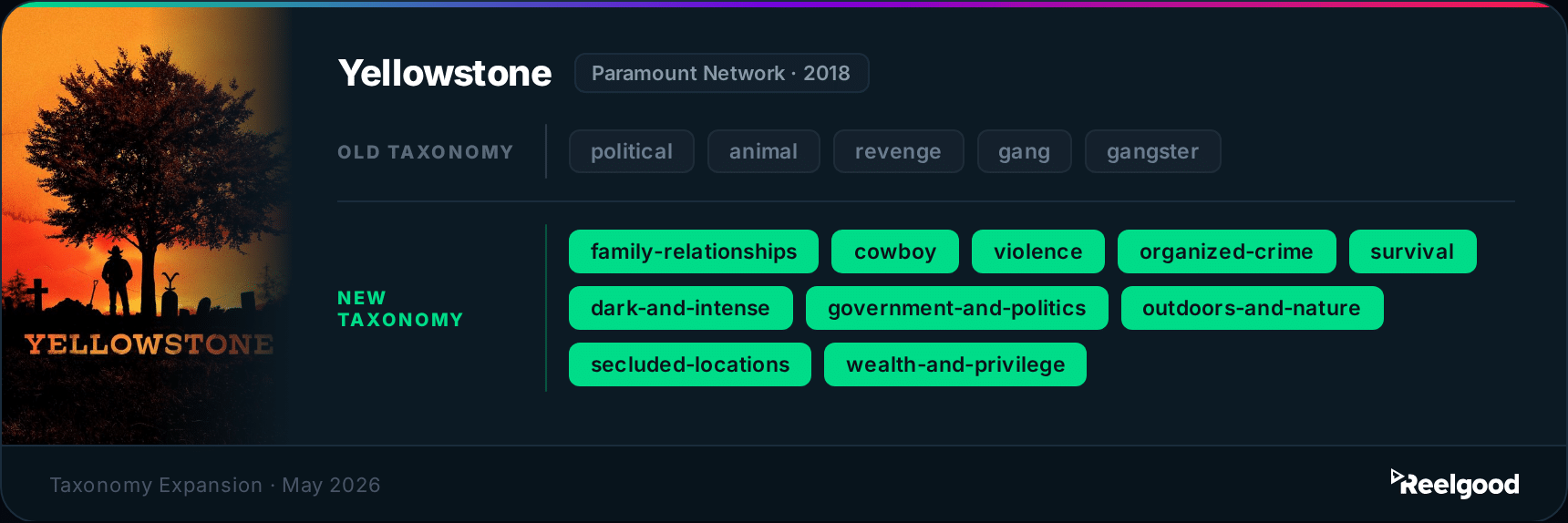
Yellowstone’s old tags described surface-level conflict. The new set reflects the show’s world, tone, and central themes.
Yellowstone (Paramount Network, 2018): Old tags (political, animal, revenge, gang, gangster) gestured at the show’s conflict and setting but missed almost everything that makes it distinctive. New tags: family-relationships, cowboy, violence, organized-crime, survival, dark-and-intense, government-and-politics, outdoors-and-nature, secluded-locations, wealth-and-privilege. The expansion captures what Yellowstone actually is: a power struggle rooted in land, legacy, and family — set against a specific world that the old tags couldn’t describe.
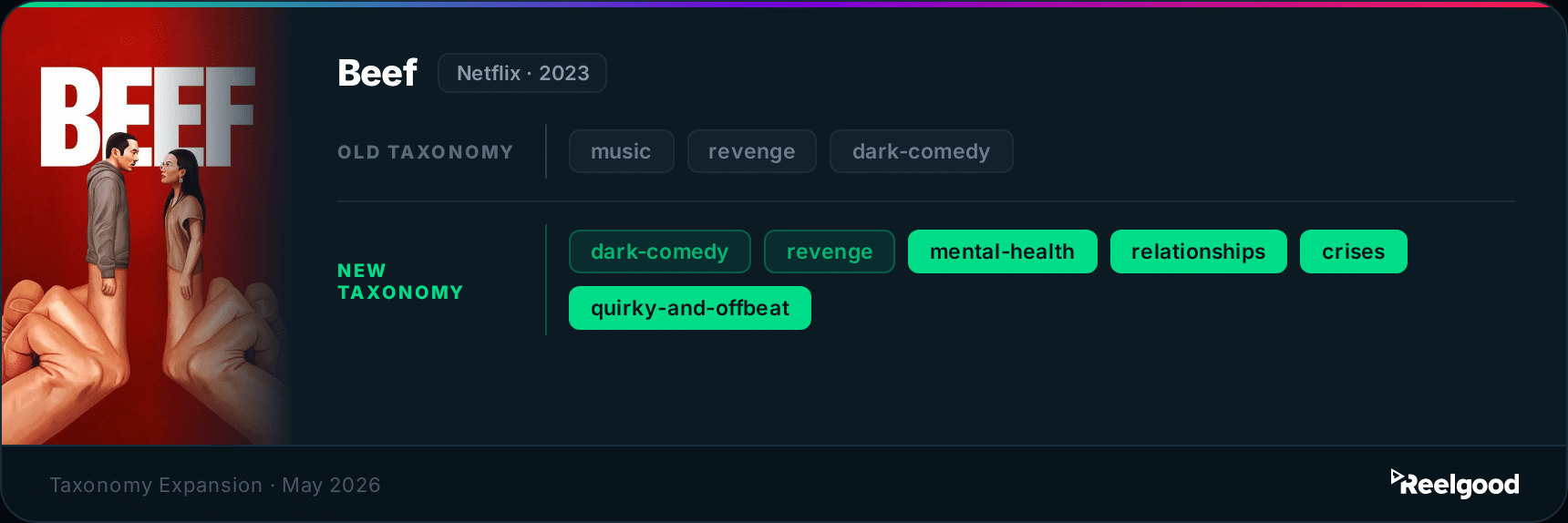
Beef gained four tags in the expansion, adding mental health, relationships, and tone signals missing from the original classification.
Beef (Netflix, 2023): The original tags (music, revenge, dark-comedy) got part of the story. But they missed the psychological and relational elements that define the show’s actual appeal. New tags: dark-comedy, revenge, mental-health, relationships, crises, quirky-and-offbeat. A viewer looking for shows that explore mental health and strained relationships now has a path to this title that didn’t exist before.
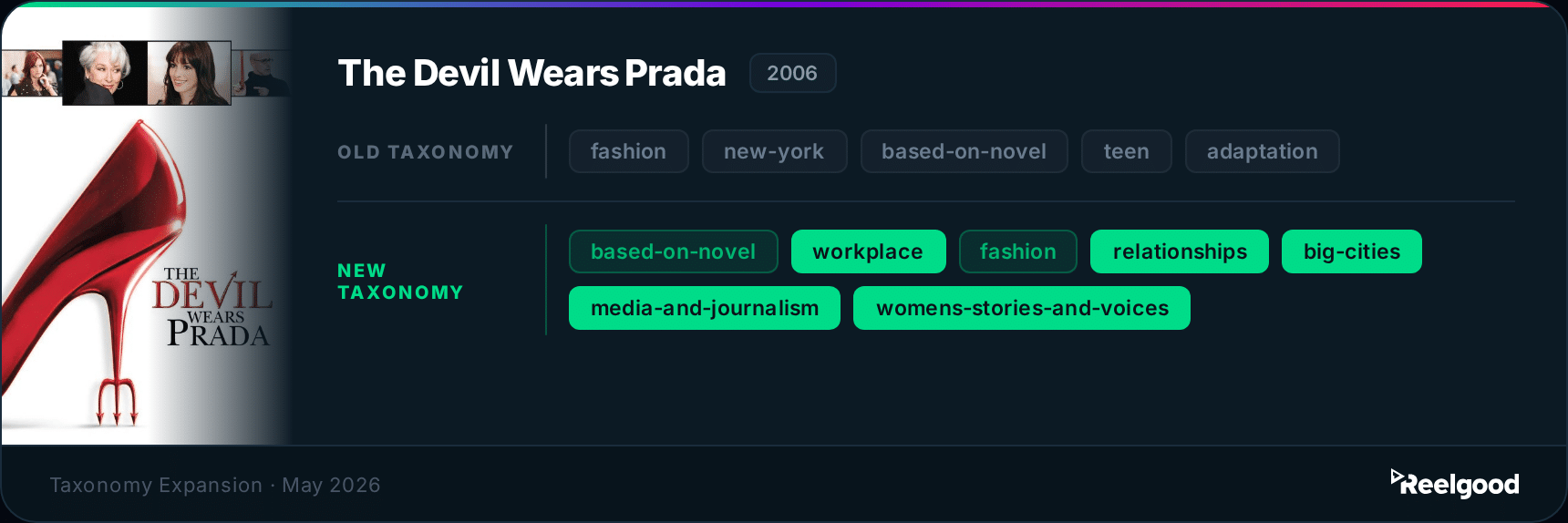
The expanded taxonomy surfaces The Devil Wears Prada as a workplace and media story, not just a fashion film.
The Devil Wears Prada (2006): Old tags (fashion, new-york, based-on-novel, teen, adaptation) were accurate but thin. New tags: based-on-novel, workplace, fashion, relationships, big-cities, media-and-journalism, womens-stories-and-voices. The additions reflect what the film is genuinely about: ambition, a high-stakes workplace, and media culture. Those are now surfaceable dimensions.
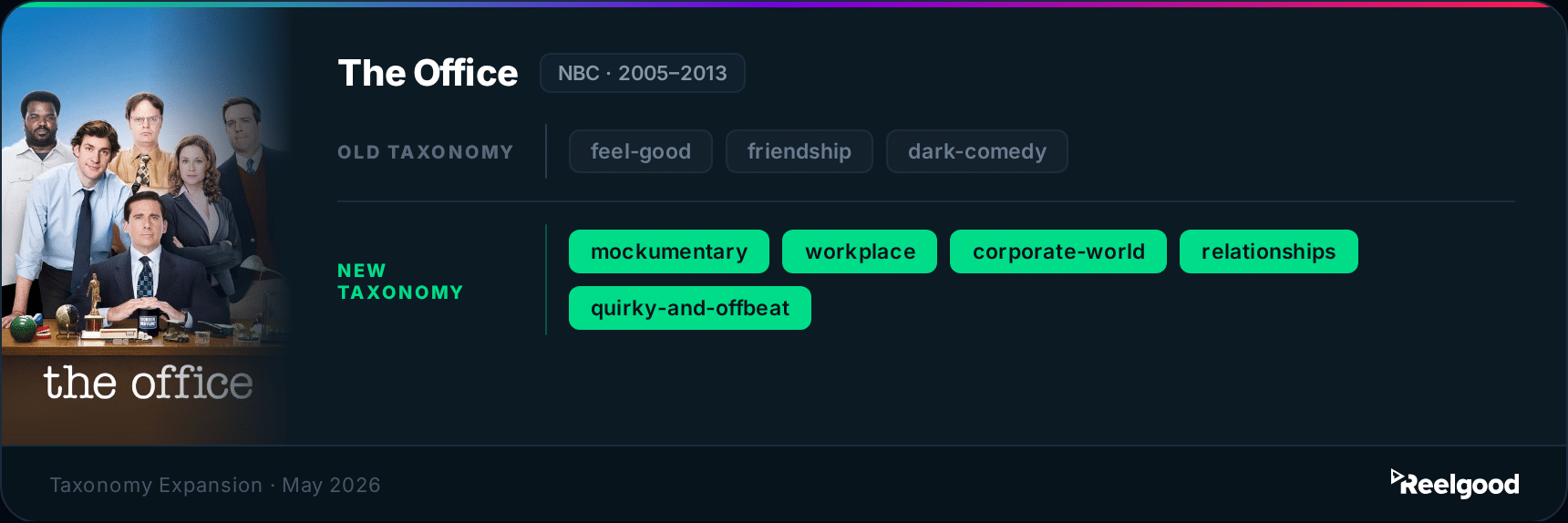
The new taxonomy captures format (mockumentary) and setting (workplace) that the original system had no tags to express.
The Office (NBC, 2005-2013): Old tags (feel-good, friendship, dark-comedy) missed the structural elements entirely. New tags: mockumentary, workplace, corporate world, relationships, quirky-and-offbeat. For viewers drawn specifically to the mockumentary format, or for any discovery system filtering by workplace comedy, this title is now findable in the way it always should have been.
The Quality Controls Behind the Expansion
Adding tags at scale is straightforward. Adding accurate tags at scale is a different problem.
Every tag assignment clears a vetting process that analyzes relevancy.
Tags aren’t applied because a topic appears somewhere in a title’s description. They’re applied when that topic is a meaningful element of the content experience. This is how we prevent the tag dilution that makes metadata less useful, not more.
Titles are capped at 10-12 tags. That ceiling is deliberate. A title with 40 tags tells you everything and nothing. We’d rather have six highly relevant tags than twelve marginal ones.
The taxonomy also includes explicit differentiation rules for categories that are easy to conflate: anime vs. animation, holiday-specific content vs. general seasonal content, and others.
Those distinctions matter for recommendation systems where precision drives performance. It’s the same kind of rigorous approach we apply to content matching, described in more detail in The Data Whisperer post.
What Content Teams Can Build With Expanded Taxonomy
The practical value of the expanded taxonomy varies by function. A few use cases worth naming specifically:
- Recommendation and discovery teams now have significantly more signal per title. When a viewer watches two shows tagged workplace, relationships, quirky-and-offbeat, a system can surface a third with far more confidence, grounded in specific content attributes rather than genre proximity. This is the kind of signal that separates a recommendation system that feels intelligent from one that just recycles the same top-ten list – and performs better to give users their next watch.
- AVOD and ad-supported streaming teams get more granular brand-suitability signals. Tone and theme tags let ad-serving logic go beyond genre to avoid placements adjacent to content that doesn’t fit a brand’s parameters, or to actively target the tonal context a brand wants.
- Search and content discovery product teams can build more precise filtering experiences. A user looking for feel-good shows set in small towns now has multiple addressable tag dimensions to filter against. The taxonomy supports the kind of nuanced, faceted search that basic genre classification never could. See Reelgood’s streaming data use cases for more on how teams apply this data.
- Content acquisition and licensing teams can query the catalog more precisely: finding all titles tagged with a specific thematic combination, identifying coverage gaps in a catalog segment, or benchmarking against competitor libraries. As we covered in The Measurement Gap, the teams with the sharpest catalog intelligence are increasingly the ones making better acquisition calls.
What’s Changing in Your Dataset
The expanded taxonomy is already live across the full library. Every title, all 288,806 movies and 72,011 TV shows, has been re-evaluated and recategorized using the expanded genre and tag set. That means the richer, more precise tags are in your dataset now, not on a future roadmap.
Importantly, no existing genres or tags have been removed. Specific tag or genre assignments for a given title may have been updated to improve its classification, but no overall tag or genre was removed from the Reelgood dataset. Any workflow, filter, or downstream system that depends on a specific existing tag continues to work exactly as before. The expansion is purely additive: the old genres and tags remain, and the new ones are now alongside them for every title.
For teams not yet using Reelgood’s metadata: the full expanded taxonomy is available now via API or data export. You can request a sample set against any title segment or content category.
Upgrade Your Own Content Taxonomy
If you’re evaluating how an expanded taxonomy system could improve your recommendation system, discovery feature, or catalog analysis workflow, we’re happy to walk through a sample data pull against your specific use case.
- ML and data engineering teams: Request a sample export with the full new tag set applied to a title segment of your choosing.
- Product and discovery teams: We can show how the six-dimension taxonomy maps against your current filtering and recommendation architecture.
- Analytics and insights teams: Ask us about tag coverage across specific catalog segments or content categories relevant to your market.
Reach out at sales@reelgood.com or learn more at data.reelgood.com.
Data: Reelgood Movie & TV Metadata and Streaming Availability Database, May 2026. Coverage: 288,806 movies and 72,011 TV shows across 300+ streaming services.