What’s Actually in Howdy’s Box: Inside the Catalog of Roku’s Ad-Free SVOD
Roku’s Howdy is having a moment.
CEO Anthony Wood told analysts on Roku’s Q1 2026 earnings call that the $2.99-a-month ad-free service is “doing extremely well,” and Antenna estimates Howdy has accounted for 23% of all Roku Channel subscription signups since its August 2025 launch. The Hollywood Reporter and Ars Technica have both reported that the service has crossed or is approaching one million subscribers in under a year.
Subscriber growth is one story. The catalog is another.
We pulled eight months of daily Howdy availability snapshots from the Reelgood Streaming Availability Database to look at what the service is actually offering U.S. subscribers: how big the library is, what it is made of, and how it compares to the way Howdy has been positioned publicly.
The short version: Howdy is not a new-release service.
It is a deliberately curated library of older mainstream movies and shows, with a thin layer of unscripted Roku Originals on top. That framing matches what Wood said on the earnings call. The data adds specificity the public coverage hasn’t.
Key Takeaways
- Half of Howdy’s U.S. catalog was released between 1997 and 2014. Median release year is 2006 for movies and 2012 for TV shows. Only 6.3% of titles are within five years of their release date.
- Drama is the load-bearing genre. Drama appears on 31% of all genre tags across Howdy’s movies, and leads the TV side as well. Action, Romance, Comedy, and Crime fill out the rest.
- The thematic tag mix reads comfort viewing. The most common movie tags include adaptation, psychology, police, based-on-novel, animal, doctor, war, survival, religion, and feel-good.
- Howdy is a movie-led service. Across 248 daily snapshots between September 2025 and May 2026, movies have averaged 78% of the catalog. The ratio has held in a 72%-to-84% band and never inverted.
- Catalog highlights are recognizable mainstream titles, not exclusives or new releases. The Matrix, Sicario, La La Land, The Imitation Game, and The Devil’s Advocate lead the movie catalog. Hell on Wheels, Line of Duty, and Longmire lead the TV side.
Howdy Is a Library Service, Not a New-Release Service
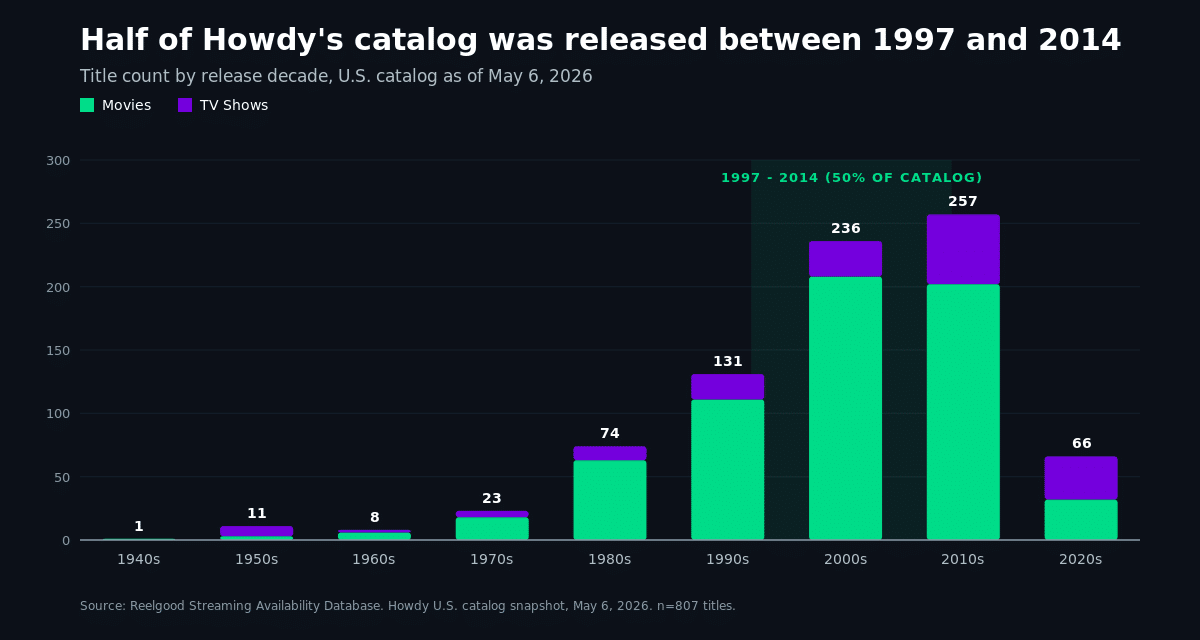
This is the most important thing the data shows about Howdy.
Of the 807 titles in the U.S. catalog on May 6, 2026, only 51 were released within the past five years. Half the catalog was released between 1997 and 2014. The median release year is 2006 for movies and 2012 for TV shows.
The shape is a long tail: drama-heavy mid-budget movies from the 2000s and 2010s as the spine, the 1990s as a meaningful supporting decade, and a small vintage layer that includes 1950s Westerns and a handful of pre-1970s classics.
This positioning matches what Wood told analysts.
He described Howdy as content “for people who want a less expensive option that doesn’t have ads,” and pointed at “iconic rom-coms, medical dramas, ’90s comedy, feel-good classics” as representative examples. At a $2.99 price point,
Howdy isn’t competing with the deep premium libraries we covered in our analysis of the only three streaming catalogs that aren’t shallow.
It’s offering a different promise: a curated set of recognizable older titles, ad-free, for less than the cost of a single rental on a TVOD service.
Drama Leads. Action and Romance Fill It Out.
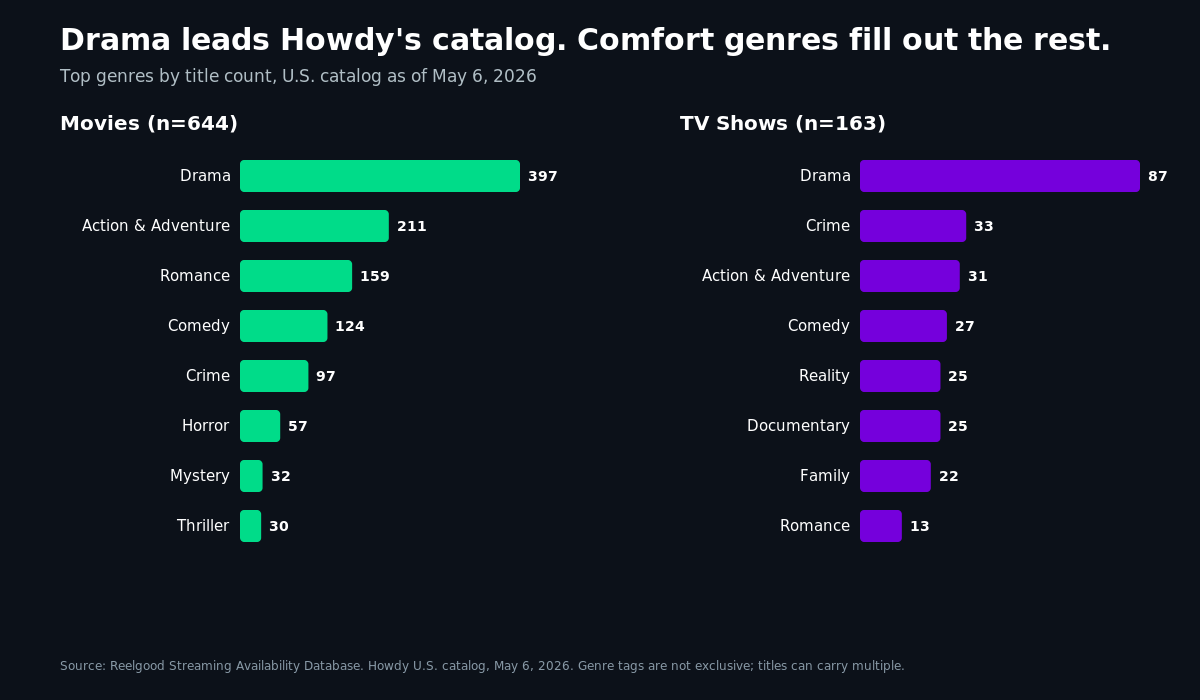
Genre composition reinforces the comfort-viewing framing.
On the movie side, Drama appears as a tag on 397 of 644 titles, or 31% of all genre tags assigned. Action & Adventure (211), Romance (159), Comedy (124), and Crime (97) round out the top five. On the TV side, Drama leads even more decisively (87 of 163 shows), with Crime, Action, and Comedy series alongside.
The TV side is also where Howdy starts to differentiate itself meaningfully from the movie catalog.
Reality TV (25 shows) and Documentary (25 shows) together make up nearly a third of the TV library, and Family-friendly programming has a stronger relative footprint. These are categories where Howdy is not going to compete with Netflix or Hulu. They are categories where licensing is cheap and viewer demand is durable.
The Tag DNA Reads Comfort Viewing
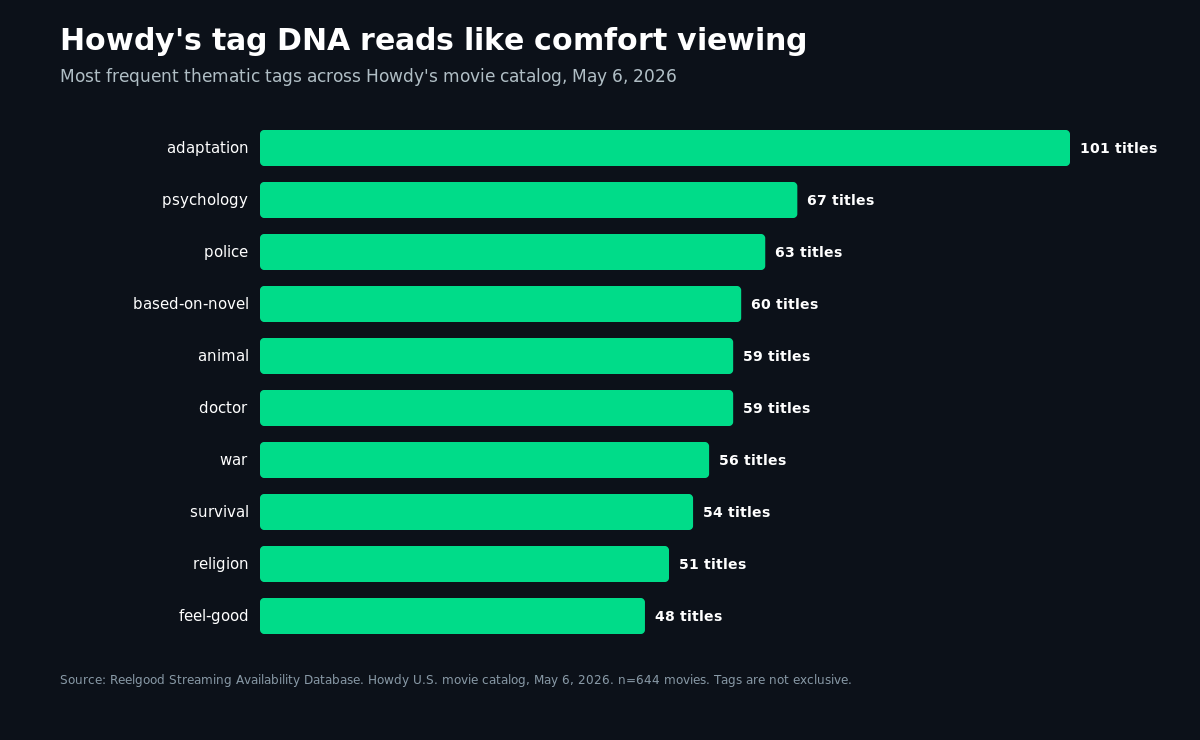
Reelgood’s metadata tags are thematic descriptors that go beyond genre.
They tell you what a service feels like to watch. The top tags across Howdy’s 644-movie catalog are striking: adaptation, psychology, police, based-on-novel, animal, doctor, war, survival, religion, and feel-good.
That is not a prestige library, and it is not a niche genre service.
It is a list of broad, durable themes that play across age groups and political lines. It is the tag fingerprint of a service designed to be on while you fold laundry.
This is consistent with what Wood explicitly told analysts.
He said Howdy is going after “a segment of the market that’s not currently served,” at a price point engineered for households trying to bring their streaming bill down. The catalog is built for that audience. There is almost nothing in the tag mix that requires close attention or sustained narrative engagement.
Howdy Is a Movie-Led Service
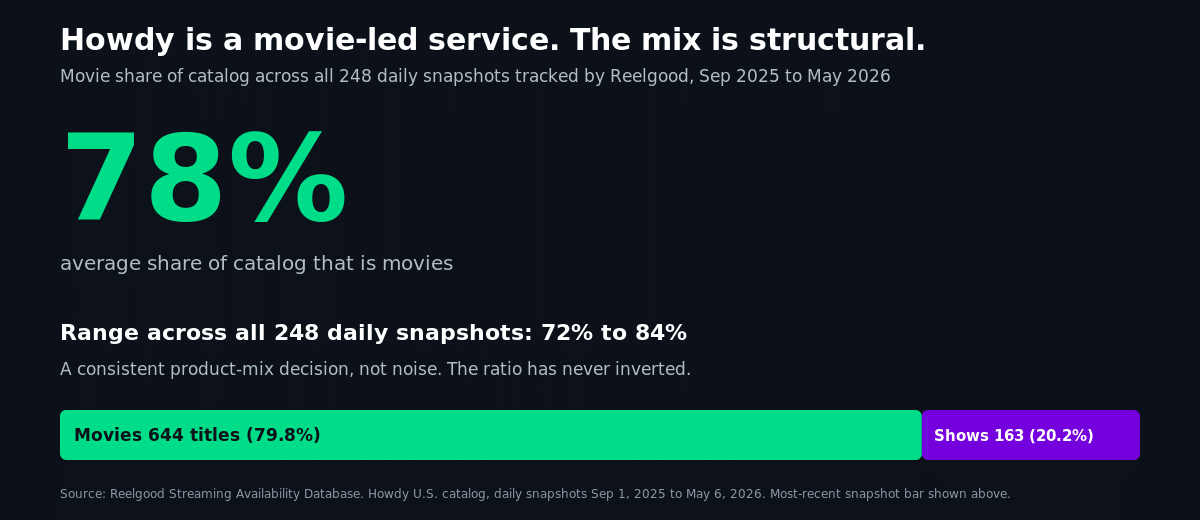
The other structural finding is the movie-to-TV ratio.
Across 248 daily snapshots, movies have averaged 78% of Howdy’s catalog. The ratio has held in a narrow 72%-to-84% band, and it has never inverted.
This matters because it differentiates Howdy from its sibling product, the Roku Channel, which leans heavily on ad-supported linear and FAST channels with a substantial TV component.
Howdy is a movie service first. Subscribers who sign up are signing up primarily for the movie shelf, with a curated TV layer that extends session length.
For licensing teams that benchmark catalog mix across services, this is a clean, defensible structural number to anchor against.
Catalog Highlights
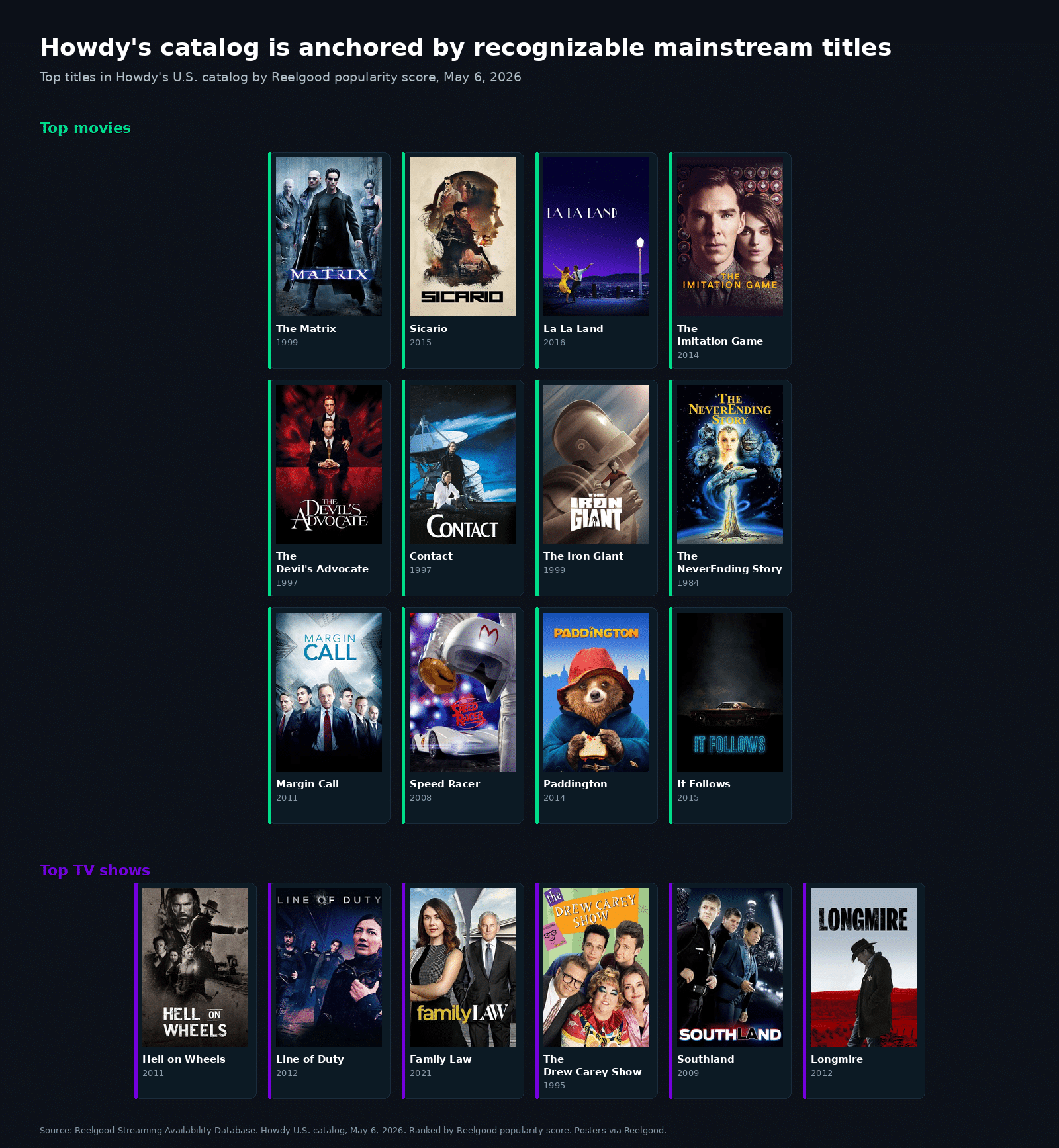
Recognition matters more than originality at this price point.
The titles ranked highest by Reelgood’s popularity score on the May 6 snapshot are mainstream catalog titles that have circulated on multiple services already: The Matrix (1999), Sicario (2015), La La Land (2016), The Imitation Game (2014), The Devil’s Advocate (1997), Contact (1997), The Iron Giant (1999), The NeverEnding Story (1984), Margin Call (2011), Speed Racer (2008), Paddington (2014), and It Follows (2015). On the TV side: Hell on Wheels, Line of Duty, Family Law, The Drew Carey Show, Southland, and Longmire.
These are not exclusives. They are titles that subscribers will recognize from previous streaming windows on Netflix, Hulu, HBO, AMC, or various AVOD platforms.
Howdy’s offer to consumers is not “we have something you can’t get elsewhere.” It is “we have things you’ll recognize, for less, with no ads.”
Howdy’s Originals Footprint Is Small and Unscripted
Wood was careful to distinguish Howdy’s originals strategy on the call.
He said Howdy has no plans for scripted blockbuster originals, but carries some unscripted Roku Originals.
Our data confirms this. On May 6, only two titles in the catalog credit Roku as a producer, both unscripted: The Great American Baking Show (2023) and What Drives You (2025). Three additional Roku-credited titles (The Charlie Puth Show, The Happy Mess Method, Honest Renovations) appeared during the tracking window.
That is a thin but precise footprint.
Howdy is, by the CEO’s own description and our title-level confirmation, almost entirely a licensed-library product.
Why This Matters
For licensing and acquisition teams, Howdy is a useful new comparable for library strategy at a sub-$3 price point.
The mix Howdy has chosen, mid-budget Drama and Action from the 2000s and 2010s anchored by recognizable mainstream titles, is the kind of catalog you build when you can’t outbid Netflix for new windows and you don’t want to. \
For competitive intelligence and analytics teams, Howdy is a proof point that a viable U.S. SVOD strategy exists at the low end of the market without originals, prestige drama, or a deep blockbuster library.
For product and platform teams building “where to watch” features, the launch is a reminder that the U.S. SVOD market is still adding services, even as headline coverage focuses on consolidation.
Want to See the Data?
Reelgood maintains a daily-updated catalog of every title on Howdy and 300+ other streaming services worldwide, with historical availability going back several years. If your team is benchmarking new SVOD entrants, evaluating the lower-end market, or building competitive catalog dashboards, we can pull a Howdy data set in the format you need.
To request a sample export, see the data dictionary and request form or email sales@reelgood.com.
Data: Reelgood Streaming Availability Database. Howdy U.S. catalog, daily snapshots from September 1, 2025 through May 6, 2026. Snapshot statistics use the May 6, 2026 reading (n=807 titles). All Wood quotes from Roku’s Q1 2026 earnings call as reported by StreamTV Insider on May 4, 2026.