Rights Windows Say What Should Happen. Streaming Availability Data Shows What Did.
A studio’s compliance team recently walked me through how they confirm a licensed title came down when its window closed. The process: someone opens the platform, searches for the title, and checks whether it is still there. If a partner was supposed to have pulled a title last quarter, they send an acknowledgment letter and trust that it happened. There is no objective record of whether the title actually streamed on any given day.
That is the distance between a rights window and reality.
The same problem shows up well beyond compliance: acquisition and competitive teams decide what to buy, how to price it, and where it moves next, often without an actual record of what the market did.
The Streaming Wars published a clear explainer last week on how rights windows work, walking through the full lifecycle of a title across theatrical, PVOD, TVOD, SVOD, broadcast, FAST, and international markets. One line stuck with me:
Rights windows do not just live in contracts. They show up in catalog movement, service migration, and exclusivity periods.
You can watch them happen.
Watching them happen, precisely and at scale, is the problem streaming availability data solves. It matters most to three functions: rights management, content acquisition, and competitive intelligence.
Key Takeaways
- Reelgood tracks title availability across 300+ streaming services globally, updating every few minutes, with historical records in the US going back to 2019.
- A rights window defines what a contract permits. It does not confirm what happened in the market. Availability data is the observable record of what actually did.
- Real-time availability answers where a title is streaming now. Historical availability answers where it has been, and for how long, at day-level precision.
- Historical availability is the one input a team cannot build after the fact. It requires accurate daily records captured at the time, which Reelgood has kept since 2019.
- Rights and compliance teams use this data to verify titles are live when they should be and gone when they shouldn’t. Acquisition teams use it to see which services are buying which content, and in which windows.
- Most teams still track windowing with manual spot-checks and monthly spreadsheets that are out of date the moment they are compiled.
A Rights Window Is Intent. Availability Is Behavior.
A rights window is a contractual promise: this title, on this platform, in this territory, under this business model, for this period. It describes what is supposed to happen. It does not tell you what did.
Contracts and market behavior drift apart constantly.
A title lingers past its window because no one pulled it. A sublicensee exploits a title it was not cleared for. A regional partner runs content that was licensed somewhere else. None of that shows up in the contract. All of it shows up in availability data.
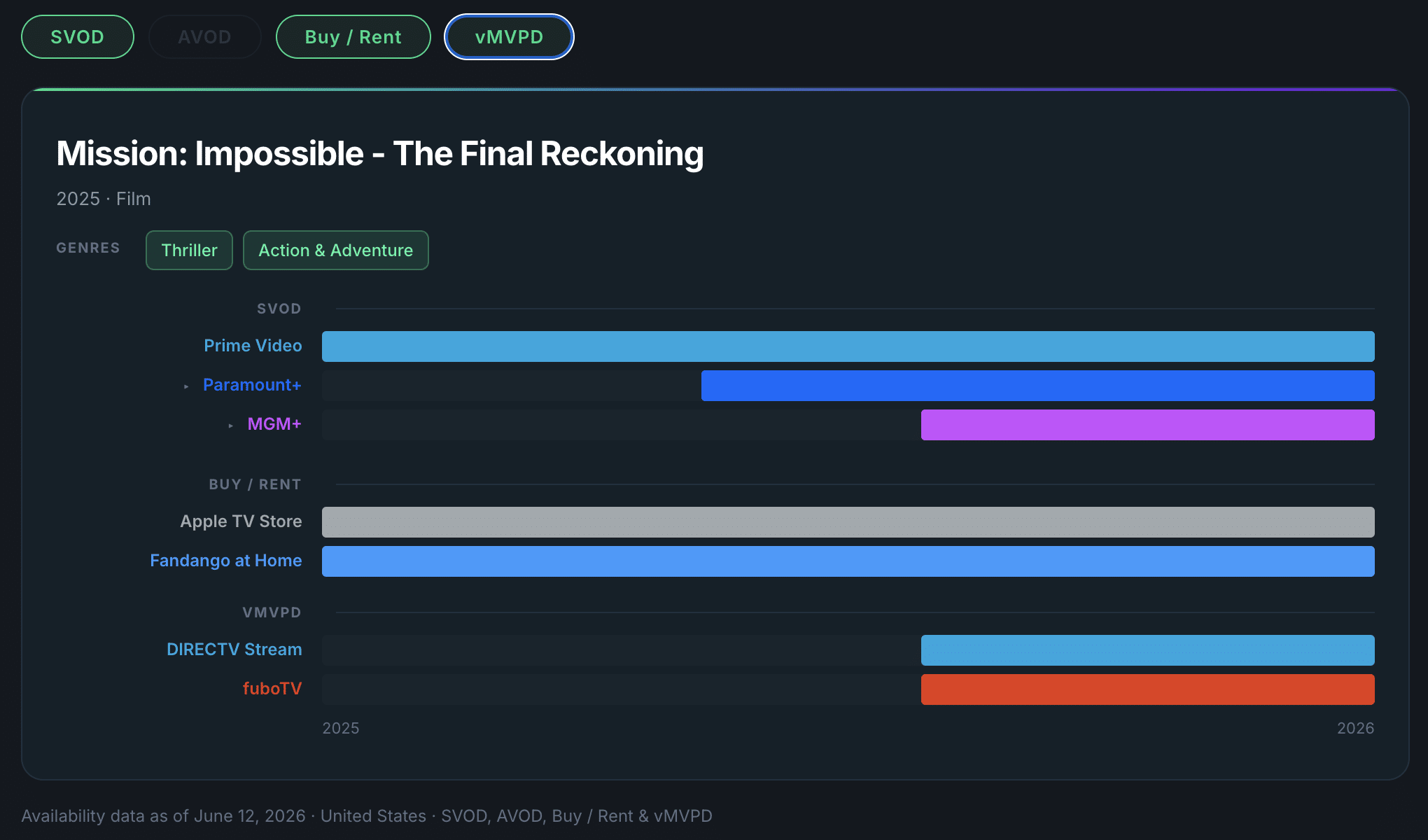
Historical U.S. availability for Mission: Impossible – The Final Reckoning, showing how one title’s windows open and close across SVOD, Buy / Rent, and vMVPD services on different schedules. Source: Reelgood streaming availability data, as of June 12, 2026.
This is the distinction the industry tends to collapse. As the article notes, a title is never simply “available” or “unavailable.” It is available in one country, restricted in another, exclusive to one model, blocked from another. The only way to know which is true, on a given day, is to observe it.
That is why we have argued that historical streaming availability data is a strategic necessity, not a nice-to-have.
The Compliance Blind Spot: Proving a Title Was Live When It Should Be, and Gone When It Shouldn’t
Rights holders licensing content out have almost no objective way to verify that their partners honored the deal.
The compliance team I mentioned put it plainly:
They need to confirm titles are live when they should be, and gone when they shouldn’t.
Today that means spot-checking platforms by hand and mailing acknowledgment and cease letters. It is slow, it is partial, and it leaves no historical record. When a title was supposed to leave a service six months ago, “I checked and it’s gone now” is not the same as knowing whether it stayed up for the three months it shouldn’t have.
Day-level historical availability answers that directly.
It shows the exact date a title joined and left each platform, in each country, going back years.
A compliance or third-party audit team compares that observed record against the contract terms they hold. Reelgood supplies what happened in the market. The customer supplies what was supposed to happen. The mismatch is where the revenue leakage and the legal exposure sit.
For rights management and audit teams, this turns a manual, reactive process into an evidence trail.
Acquisition and Pricing Run on What the Market Actually Did
Every acquisition and licensing decision runs on a question the contract can’t answer: what has the market actually done with titles like this one?
Content acquisition leads describe the same need in their own words.
They want to see which services are buying which content, and in which windows. How long comparable titles held their SVOD run before shifting to AVOD. When a genre stopped selling to a particular buyer. Which competitors have gone quiet in a category, and which are loading up.
A single snapshot of who has what today cannot answer those questions. A multi-year record of how catalogs moved can.
Acquisition teams use windowing history to price content, model greenlight decisions, and pressure-test where a title should land next. This is one of the most common reasons teams come to us, and it sits at the center of our streaming data use cases.
For content strategy and acquisition, availability history is the difference between negotiating from anecdote and negotiating from the market’s actual behavior.
Real-Time Availability Is the Other Half of the Picture
Historical data tells you where a title has been. Real-time data tells you where every title is right now, across 300+ services.
The same dataset that answers a viewer’s “where can I watch this tonight” answers a strategy team’s “what did our competitor just add, and where.” Reelgood’s real-time availability powers streaming discovery for companies including Google and Perplexity, and it feeds competitive catalog monitoring for numerous streaming services tracking rival libraries as they change.
The value is in the freshness.
A competitor’s catalog you audited last month…is a competitor’s catalog from last month.
We wrote more about why streaming teams need faster answers as catalogs shift week to week. Real-time and historical together give you both the current state and the trajectory.
Why This Is Hard to Solve Internally
The obvious question is why a team can’t just build this. Two reasons.
First, real-time coverage is a maintenance problem, not a one-time build.
Tracking 300+ services across dozens of countries, each with its own structure and its own habit of changing without notice, means the data decays daily. Scraping it yourself is unreliable and legally risky, which is part of why teams move off DIY and away from legacy sources – especially those providers that often lock you in
Second, and more fundamental: you cannot reconstruct history you did not capture.
If you start tracking a title today, you have today forward. You have no way to answer where it was in 2022 unless someone was recording it, accurately, every day, back then. Reelgood has been. That back catalog of daily observations is the part no team can build retroactively.
What Reelgood Provides: Title Availability Intelligence
Reelgood’s streaming title availability data covers 300+ services globally across SVOD, AVOD, and TVOD, at 99+% accuracy verified by ML, updating every few minutes. Historical availability is recorded at day-level precision, going back to 2019 in the US and progressively across other markets. It does not include contract terms and it does not predict future windows: it is the observed record of where every title has been and is now, which teams pair with their own rights data to answer the questions above.
This is not a hypothetical dataset. One major studio has run on Reelgood data for years, using it to inform more than $5 billion in licensing decisions, and the data has won competitive evaluations against legacy providers at some of the largest technology and streaming companies in the market.
If your team is working through any of these, we can pull a sample against your own titles so you can see the shape of the data:
- Rights and compliance: request a day-level availability history for a set of your licensed titles, across the platforms and countries you care about.
- Content acquisition and strategy: request a windowing and buying-pattern breakdown for a genre or a competitor’s catalog.
- Product, search, and discovery: request API documentation and a real-time availability sample.
Start at data.reelgood.com or email sales@reelgood.com.
Data: Reelgood Movie & TV Metadata & Streaming Availability Database, June 2026. Coverage: 300+ streaming services globally across SVOD, AVOD, and TVOD. Historical availability in the US recorded from 2019.