FAST Viewing Grew 55%. Metadata Quality Now Decides What Gets Discovered
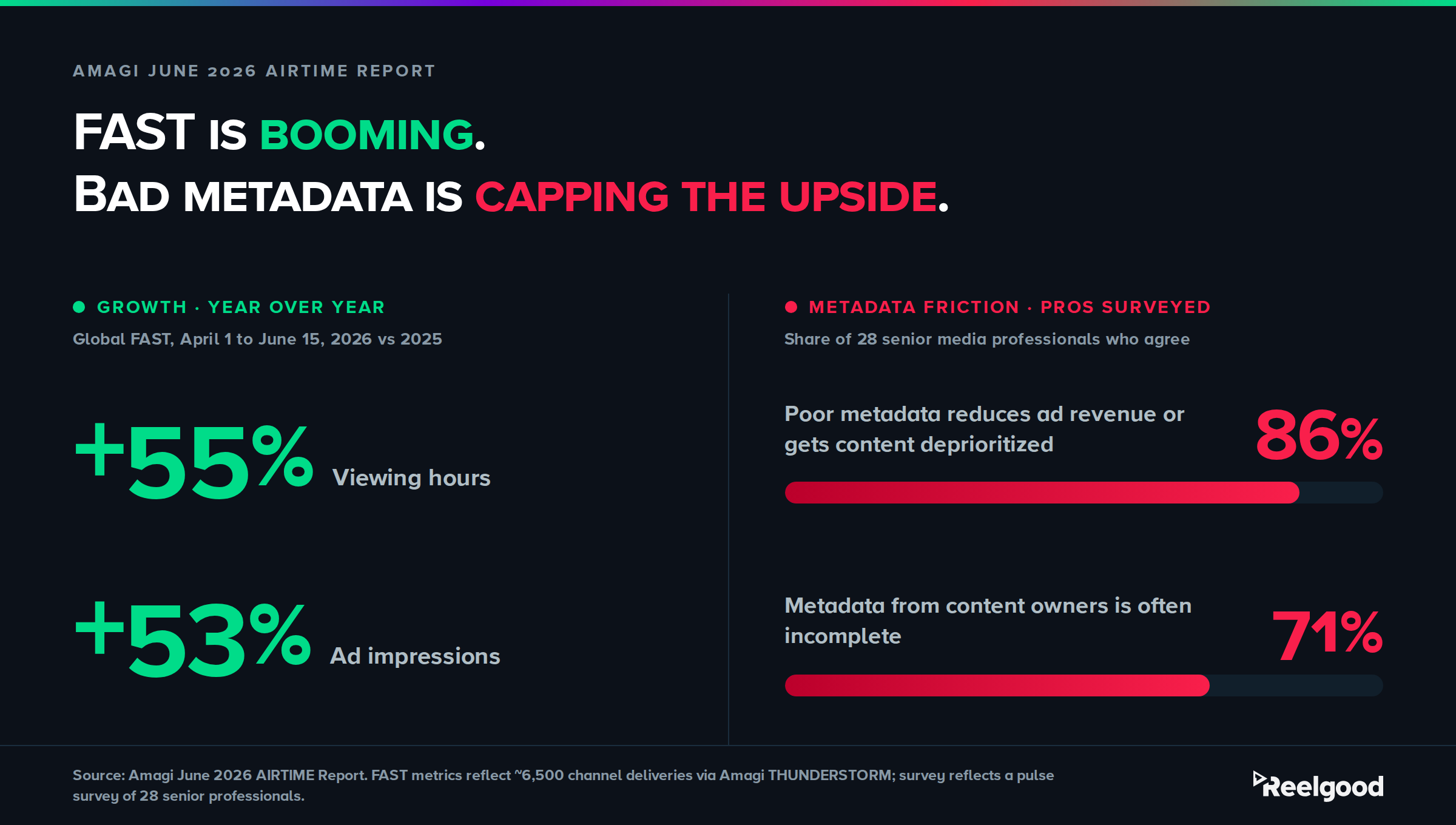
FAST viewing grew 55% year over year.
The systems that decide which of those titles anyone actually finds are choking on bad metadata.
Both facts come from the same place: Amagi’s June 2026 AIRTIME Report, which pairs that 55% jump in viewing hours and a 53% rise in ad impressions with a warning from the people who run these channels. In Amagi’s survey, 86% said poor metadata is costing them revenue, and 71% said the metadata they receive from content owners is incomplete.
That is not a delivery problem. It is a discovery problem, and it is squarely in the part of the stack Reelgood works in every day.
Key Takeaways
- FAST viewing hours grew 55% year over year in Amagi’s June 2026 AIRTIME Report, based on roughly 6,500 channel deliveries through its THUNDERSTORM platform. Ad impressions rose 53%.
- In Amagi’s pulse survey of 28 senior professionals, 86% said poor metadata directly reduces ad revenue, limits discovery, or causes platforms to deprioritize their content.
- 71% said the metadata content owners hand over is often incomplete, missing genres, ratings, imagery, or episode details. That gap is the exact thing a clean, complete metadata catalog is built to close.
- FASTMaster’s Gavin Bridge argues discovery now depends on AI agents that require richly structured metadata. Bad metadata won’t just look wrong in a grid, it will be invisible to the systems doing the recommending.
- Reelgood has won every competitive data evaluation against legacy metadata providers in bakeoffs done by the world’s biggest tech, AI, and TV brands and studios
FAST’s Growth Problem Is Now a Metadata Problem
The demand side of FAST is not the issue.
Amagi measured a 55% jump in viewing hours and a 53% jump in ad impressions across roughly 6,500 channel deliveries between April 1 and June 15, 2026. The United States and Canada still drive monetization, accounting for 54% of global viewing hours and 74% of ad impressions, while Latin America was the fastest-growing region at 190% viewing growth. Kids was the fastest-growing genre, up 191%.
The constraint is on the supply side of the data.
When Amagi asked 28 senior professionals across content owners, broadcasters, channel operators, platforms, and ad teams what hurts most, 86% pointed to metadata: reformatting it for every platform’s spec, and living with the revenue consequences when it is wrong.
The sample is small and skewed toward FAST operators, so treat it as a signal rather than a census. But it lines up with what we hear from content and product teams directly, and with what we argued in our analysis of metadata as a strategic asset:
The teams that treat metadata as infrastructure pull ahead of the ones that treat it as paperwork.
Here is the split worth keeping straight.
Reformatting a feed to meet each platform’s delivery requirements is a pipeline problem, and that is where a platform like Amagi operates.
The other half of the finding, the 71% who say incoming metadata is incomplete, is a source-of-truth problem.
Those are different jobs, and Reelgood does the second one.
Incomplete Metadata Is the Gap Reelgood Was Built to Close
This is a problem we know intimately.
When we started building our own ‘where-to-watch’ consumer product, we quickly learned that the TV & movie metadata landscape was broken.
We tried every existing metadata solution provider, including the big ones, and they all failed.
With each metadata supplier, we hit the same gaps in accuracy, completeness, and timeliness that our customers, and most companies, face today.
We realized that you cannot build a reliable discovery experience on top of fragmented, legacy data. We didn’t find a solution in the market, so we built the dataset we wished had existed from day one, powered by Reelgood AI/ML technology.
When 71% of professionals say the metadata they receive is missing genres, ratings, imagery, or episode details, they are describing a data completeness gap.
You cannot reformat a field that was never populated, and you cannot recommend a title the system cannot classify.
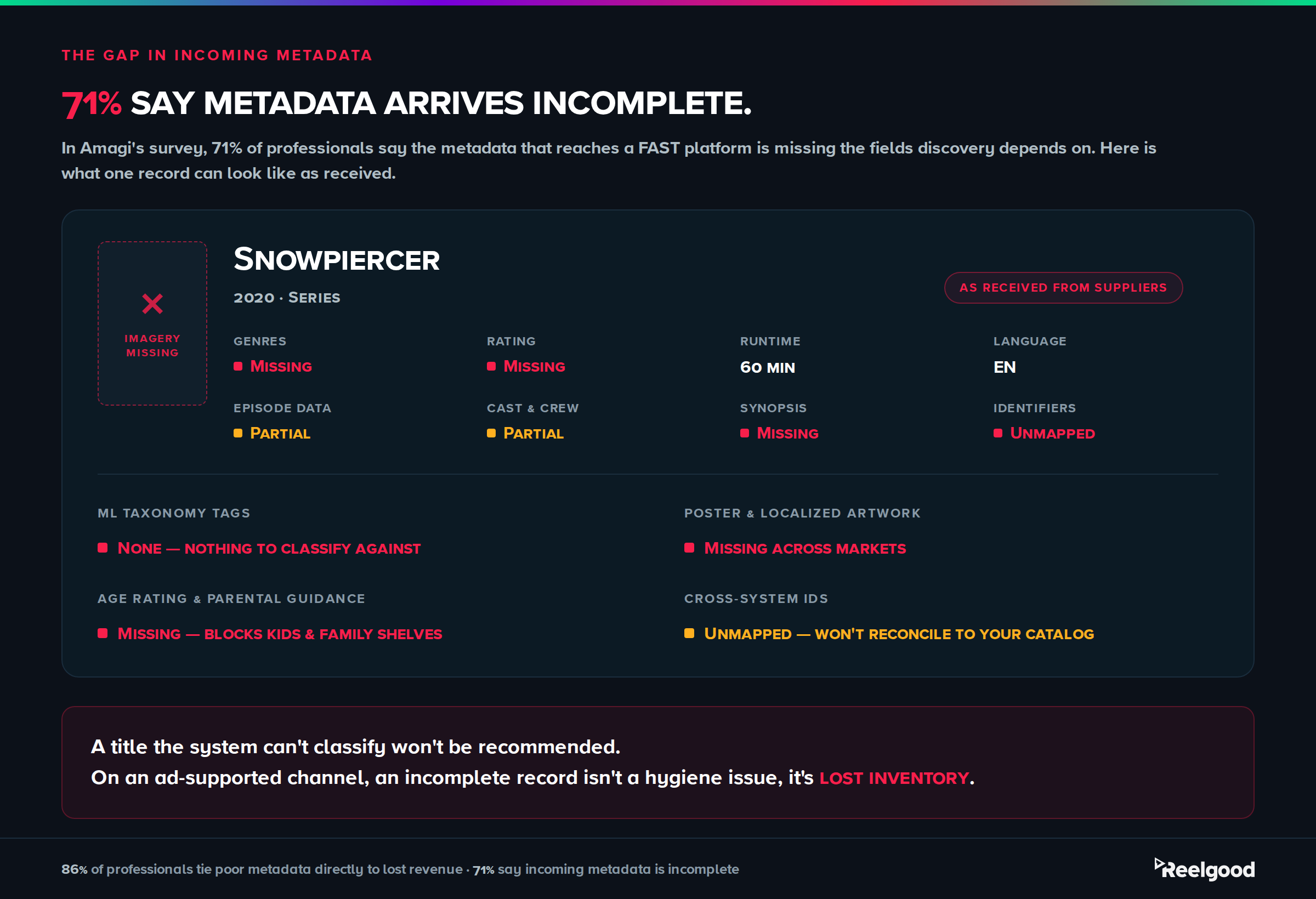
That penalty lands hardest on the genres growing fastest.
Kids, up 191% in the report, is among the most metadata-sensitive categories in streaming, leaning on accurate age ratings, parental guidance, and episode data, which makes the fastest-growing genre one of the least forgiving of a missing field.
This is Reelgood’s core competency.
We maintain cleaned, ML-normalized metadata across 280,000+ movies and 69,000+ TV shows: cast and crew, synopsis, ratings, runtime, genres, images, deep links, awards, and episode-level detail, verified at 99+% accuracy and refreshed every few minutes.
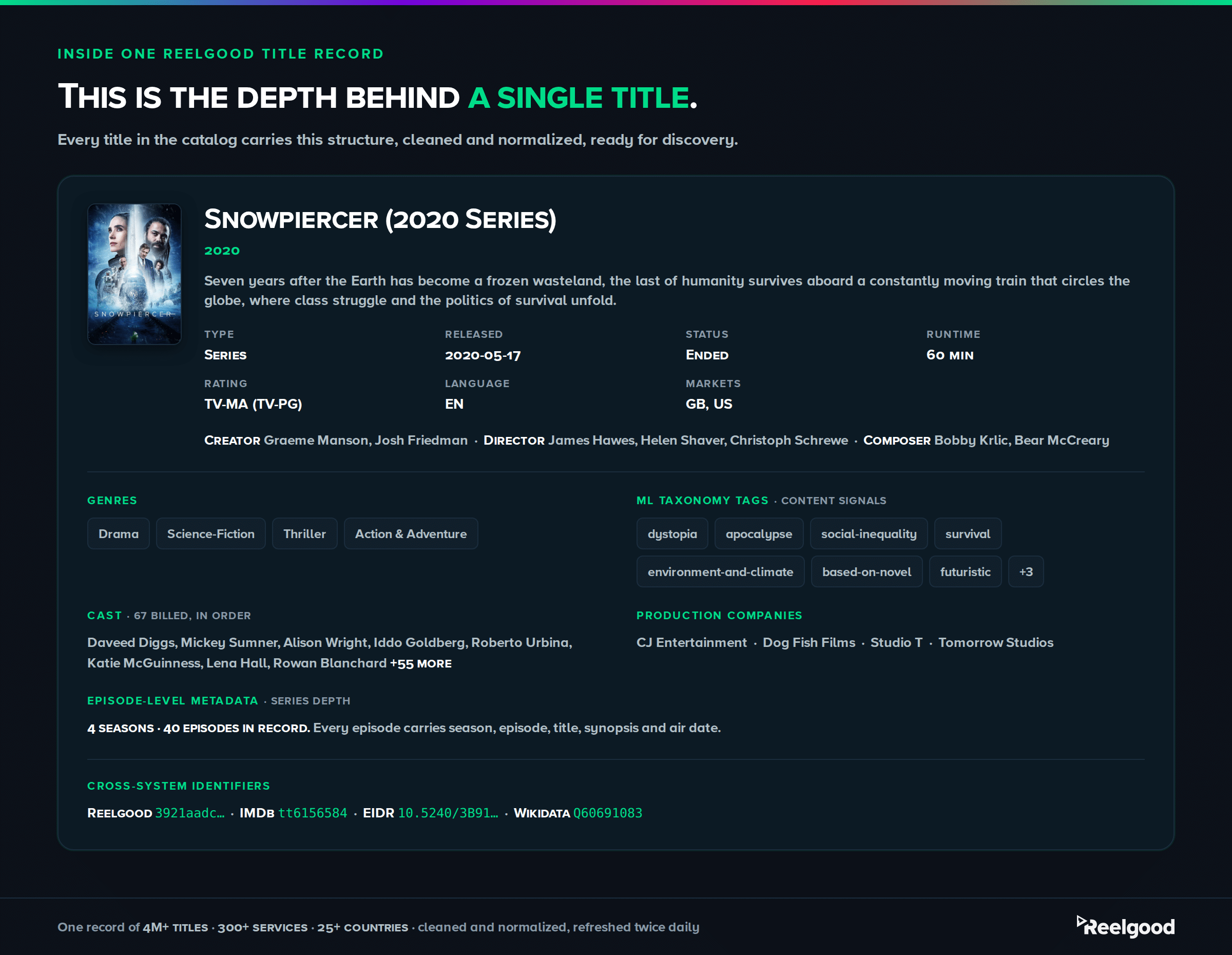
It arrives as a normalized, daily data feed or through the Reelgood API, keyed to IMDb and other common industry IDs so it maps cleanly to the catalog you already have.
For a content owner loading a catalog onto FAST, or an operator ingesting feeds from dozens of suppliers, that database is what you fill the gaps from. Where a supplier’s feed is thin, you enrich against one consistent catalog instead of chasing the supplier for a corrected asset weeks later.
The alternative most teams run today is the expensive one.
A content ops analyst opens a spreadsheet of titles with blank genre cells, cross-checks two or three free databases of uncertain provenance, hand-keys the gaps, and reconciles the ratings that three suppliers each formatted differently. That work does not scale with a catalog that is growing 55% in viewing and expanding into new regions every quarter.
The cost is not abstract. A title with a blank genre or a missing rating is harder to classify, less likely to be recommended, and less likely to earn the impressions that pay for it. On an ad-supported channel, incomplete metadata is not a hygiene problem. It is lost inventory, which is why 86% of the professionals Amagi surveyed tie it directly to revenue.
AI Discovery Runs on Structured Metadata, or It Doesn’t Run at All
Completeness is only the first bar.
A field can be filled and still be useless to the machine reading it. The most important line in the report is Gavin Bridge’s. The FASTMaster analyst argues the industry’s challenge is no longer creating metadata but making it consumable by the systems doing the recommending, human and AI alike.
His warning is blunt: bad metadata won’t just look wrong in a grid, it will be invisible to the agents deciding what surfaces.
Read that as a spec, because it is one. Agent-driven discovery needs structured, normalized, machine-readable metadata tied to stable identifiers. That is what Reelgood delivers through its S3 data feed and the Reelgood API, using open ID formats like IMDb rather than the proprietary, closed schemas of legacy cable-era providers.
Reelgood won head-to-head data evaluations against all legacy providers and supplies the metadata behind discovery on the world’s biggest search engines, AI companies, TV manufacturers, and streaming services.
Discovery systems and answer engines need entertainment metadata a machine can trust without a human in the loop, which is exactly what our ML content-matching approach is built to produce.
For a FAST platform’s product and data team, the implication is direct.
If your recommendation and search layers are only as good as the metadata feeding them, standardizing on a clean, machine-readable source is not a nice-to-have. It is the difference between a title that gets recommended and one that never appears.
The Fastest-Growing FAST Markets Are the Hardest to Cover
Latin America grew viewing hours 190% in the report, the fastest of any region. Faster growth into newer markets usually means messier data, because metadata quality tends to degrade the further you get from a title’s home territory. Genre conventions differ, ratings systems differ, and imagery and localized detail are inconsistent or missing.
Reelgood maintains title-level metadata for content across global markets, including Latin America.
For an operator or content owner expanding a FAST footprint,
Consistent metadata across territories is what keeps a catalog coherent as it crosses borders,
a point we have made before in our work on catalog fragmentation across markets. The region growing fastest is also the one where clean, consistent data earns its keep quickest.
Where Reelgood Fits, and Where It Doesn’t
Reelgood does not track FAST channel schedules or linear availability, so it will not tell you what is airing on a given FAST channel at a given moment.
What Reelgood provides is the reference layer underneath:
Complete, normalized, machine-readable title metadata for every movie and show needed to populate those channels,
so the content going into the pipeline is accurate and discovery-ready before it ships.
The report says 32% of respondents plan to invest in AI-powered metadata tools in the next year and a quarter plan to strengthen in-house capabilities.
Both paths still need a trustworthy baseline to build against. AI that generates synopses and tags is only as good as the data it checks itself against, and an in-house team is only as fast as the clean catalog it starts from.
If FAST’s next competitive edge is operational precision rather than reach, as Amagi’s own leadership put it, then the metadata layer is where that edge gets won or lost.
What to Do With This
If your team is feeling the metadata gap the report describes, here is the specific thing to ask us for.
- Content owners and distributors on FAST: Request a sample enrichment against your catalog to see where genres, tags (sub-genres), ratings, imagery, and episode detail are missing before those gaps cost you discovery. Start with the metadata request form.
- FAST platform product, data, and ML teams: Ask for Reelgood API documentation and a data dictionary to evaluate a machine-readable metadata layer for your search and recommendation systems.
- Programming and competitive intelligence teams: Request a metadata coverage check across a genre or catalog to confirm every title carries the fields discovery systems need, drawing on our streaming data use cases.
Reach the team at sales@reelgood.com.
Sources: Amagi June 2026 AIRTIME Report, as reported by Media Play News, July 2026. FAST metrics reflect approximately 6,500 channel deliveries via Amagi THUNDERSTORM (April 1 to June 15, 2026) and are not a universal measure of the FAST industry. Survey findings reflect a pulse survey of 28 senior professionals. Reelgood figures: Reelgood Movie & TV Metadata & Streaming Availability Database, July 2026.