The Star Trek Catalog Is 97 Titles. 51 Are in No Streaming Catalog at All.
This is the second of two posts marking Star Trek’s 60th anniversary with Reelgood’s US availability data. Part one covered where Star Trek actually streams and who owns those services. This one covers what is in the 97-title catalog and what is missing from it.
Key takeaways
- Reelgood maps 97 Star Trek titles in the US. Of those, 26 are the feature films and scripted series most people would name. The other 71 are documentaries, fan productions, theme park films, aftershows, and making-of specials.
- 51 of the 97 have no SVOD, AVOD or TVOD window on any commercial service. Some are freely watchable on YouTube. None are in a catalog a licensing team can see.
- All 20 pieces of official Star Trek companion content have no catalog window. 19 third-party Trek documentaries do have one, on an average of 8.5 services each.
- The only two official Paramount productions in the franchise with no catalog window are both short-form: Star Trek: Very Short Treks and Star Trek: Scouts. Both are free on YouTube.
Ask someone to name the Star Trek catalog and you get The Original Series, The Wrath of Khan, The Next Generation, maybe Strange New Worlds if they have kept up. That is 13 films and a dozen series, 26 titles in all. Reelgood maps 97, drawn from the availability record we maintain across 300+ services and 25+ countries.
The gap is where the interesting problem lives, because the 71 titles nobody would name behave very differently from the 26 everybody can name.
One definition first, because it does a lot of work below. A catalog window means a title is carried by a commercial streaming service: SVOD (subscription), AVOD (ad-supported), TVOD (buy-and-rent), or a vMVPD pay TV bundle. It does not include a video posted free to a brand’s own YouTube channel. That distinction is the point of this post, not a technicality.
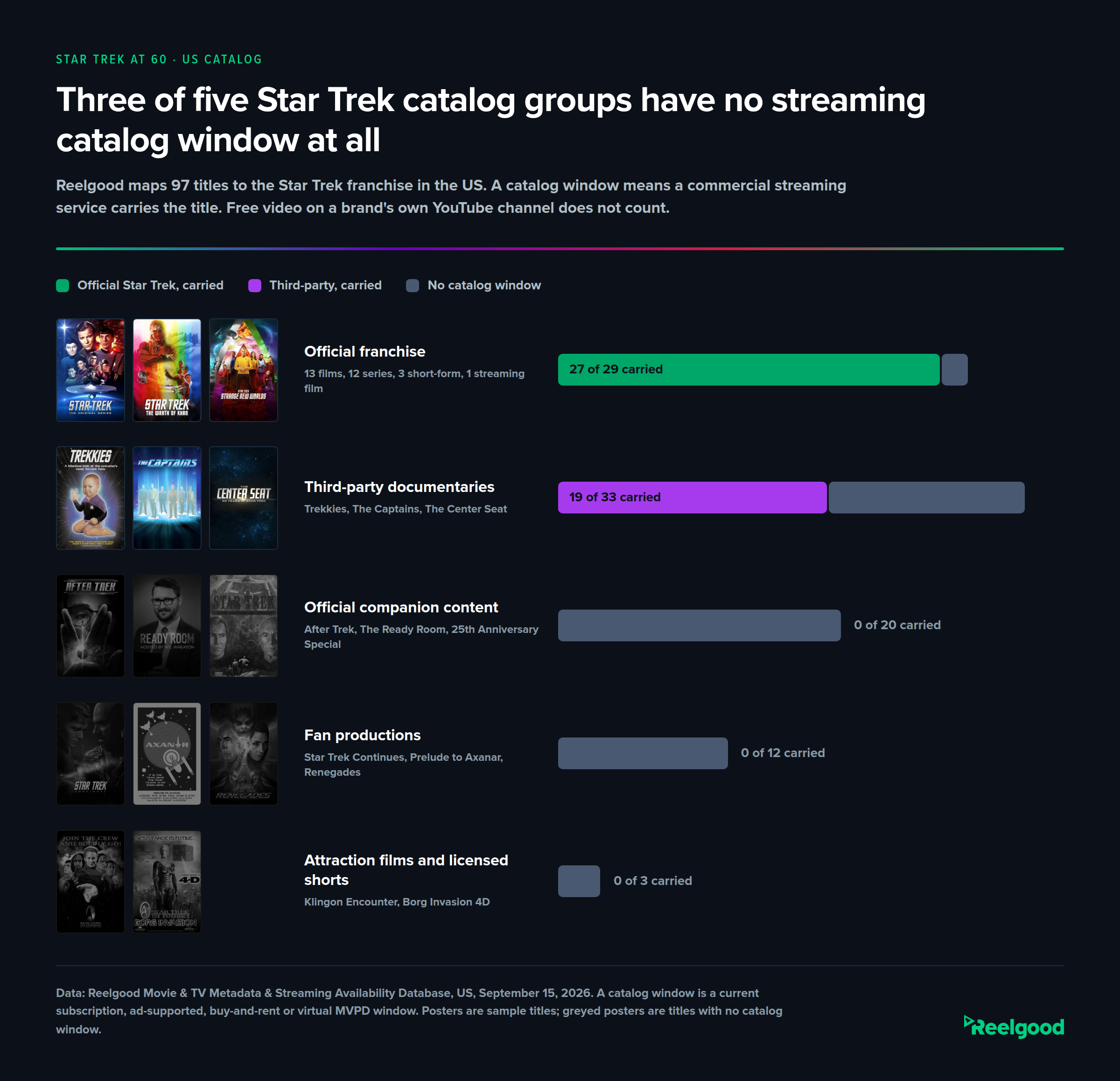
Reelgood maps 97 Star Trek titles in the US, and 51 of them are carried by no commercial streaming service. Data: Reelgood US availability, September 15, 2026.
Star Trek is 97 titles, and only 26 are the films and series you would name
The core franchise is 26 titles: 13 feature films, nine live-action series, three animated series, and one streaming film, Section 31. Add three short-form official series and the official franchise bucket reaches 29.
The other 68 fall into four groups:
- 33 are documentaries made about Star Trek by third parties, from Trekkies in 1999 to Beam Me Up, Sulu this year.
- 20 are official companion pieces: After Trek, The Ready Room, the 25th anniversary special, and the various Inside the Series featurettes.
- 12 are fan productions, including Star Trek Continues and Prelude to Axanar.
- Three are one-offs, among them the two attraction films Paramount made for Star Trek: The Experience in Las Vegas.
Franchise membership here is not a title-string match. What We Left Behind and Beam Me Up, Sulu never say Star Trek in their names, and Prelude to Axanar is an unlicensed fan production that Paramount sued over. Each title carries a franchise relationship and a content category in the streaming availability data behind this post, which is what makes the long tail visible at all.
A franchise query that returns 26 titles answers a fan’s question. One that returns 97 answers a rights holder’s question.
The difference has a price.
For a rights owner, the 20 companion titles with no catalog window are assets you own that currently earn nothing. For an acquirer, a franchise query that returns 26 of 97 means the deal memo undercounts what is actually in scope, and you find that out in diligence rather than before it.
Streaming availability data puts 51 Star Trek titles outside every commercial catalog
Of the 97 Star Trek titles Reelgood maps in the US, 51 are carried by no commercial streaming service. 27 of the 29 official franchise titles do have a catalog window, and so do 19 of the 33 third-party documentaries. After that it stops: none of the 20 official companion titles, none of the 12 fan productions, none of the three one-offs, on SVOD, AVOD or TVOD alike.
Some of those 51 are genuinely hard to see.
The two attraction films, Star Trek: Klingon Encounter and Borg Invasion 4D, were made by Paramount for a Las Vegas venue that closed in 2008 and were never commercially released.
Many of the rest are easy to watch and simply invisible to catalog systems. Paramount’s own fan film guidelines require fan productions to be distributed free and non-commercially, which in practice means YouTube, so all 12 are watchable and none are licensed. The Ready Room episodes sit on the official Star Trek YouTube channel.
This is the distinction that matters if you build or buy catalog data: publisher-direct video and licensed catalog are different things, and only one of them shows up in an availability record with terms attached to it.
Documentaries about Star Trek reach more services than Star Trek’s own extras
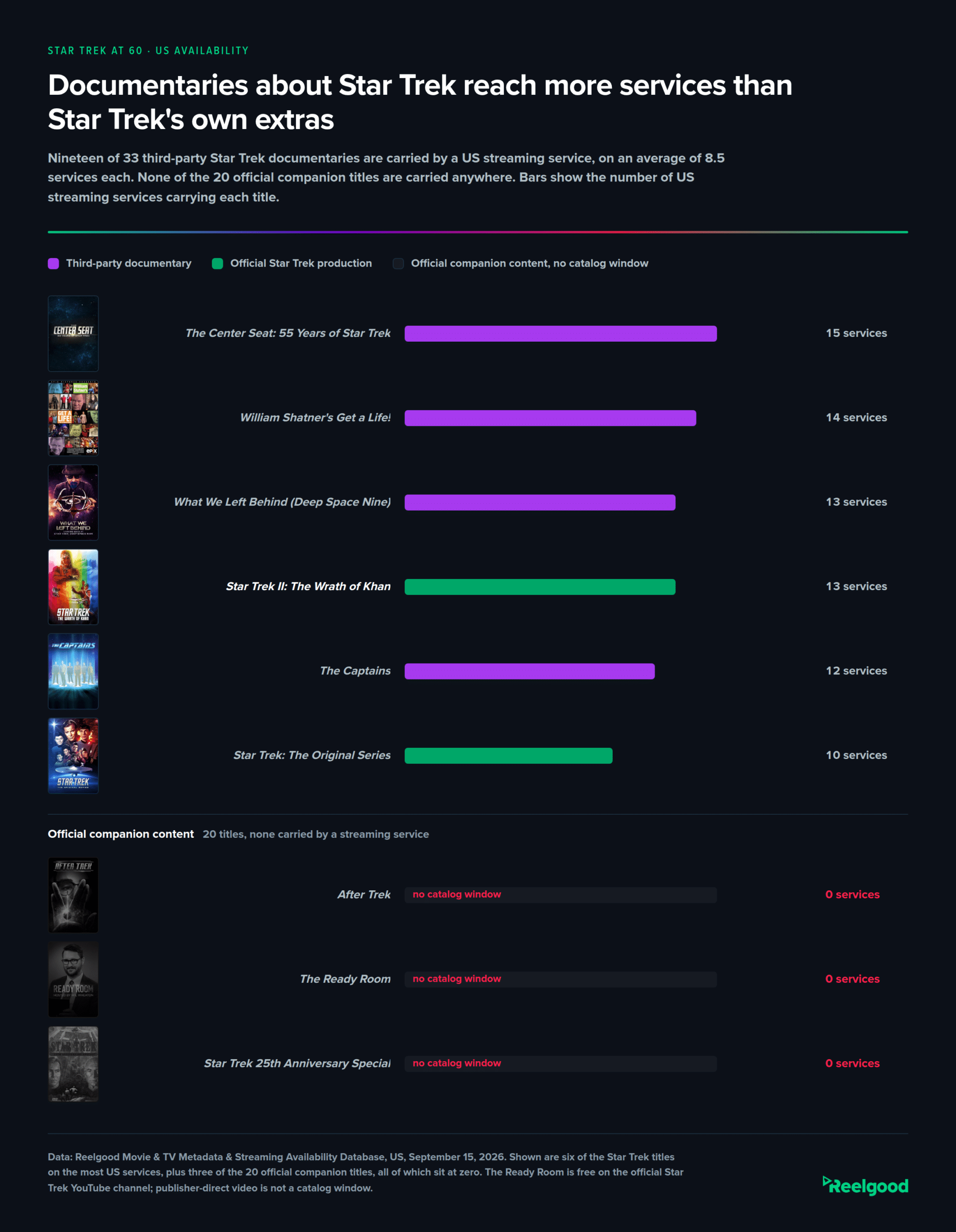
All 20 official Star Trek companion titles are absent from commercial streaming catalogs, while the 19 third-party Trek documentaries that are carried reach an average of 8.5 services each. Data: Reelgood US availability, September 15, 2026.
Of the 33 third-party documentaries, 19 have a catalog window, carried on an average of 8.5 services each. The Center Seat: 55 Years of Star Trek reaches 15. William Shatner’s Get a Life! reaches 14. What We Left Behind, the Deep Space Nine retrospective, reaches 13, the same as Star Trek II: The Wrath of Khan.
Of the 20 official companion titles, none has a catalog window. Not After Trek, not The Ready Room, not the 25th anniversary special.
The explanation is not mysterious.
An independent producer licenses a Star Trek documentary wherever it will go, because distribution is the business. A studio makes a behind-the-scenes special as a retention asset for one platform, and when the season ends and the window closes, nothing pushes it anywhere else.
The films about Star Trek outlive the studio’s own films about Star Trek because somebody had a commercial reason to keep them moving.
The line between the two groups is blurrier than the labels suggest, which is worth saying plainly. Trekkies was independently produced but distributed by Paramount Classics. What We Left Behind was crowdfunded by its own producers, and CBS remastered Deep Space Nine footage in HD for it. Studio cooperation is common. Studio distribution is what changes where a title ends up.
The two official Paramount titles with no catalog window are both short-form
The only two official Paramount productions in the franchise without a catalog window are Star Trek: Very Short Treks, the 2023 animated comedy shorts, and Star Trek: Scouts, the preschool series that launched in 2025 and returned on September 8 for a second season announced at 30 episodes, a week before this data was pulled. Both are official: Very Short Treks comes from Secret Hideout, Roddenberry Entertainment and CBS Studios, and Scouts was developed by Nickelodeon Digital Studio with CBS Studios.
Neither is hiding. Very Short Treks is free on StarTrek.com and YouTube. Scouts runs YouTube-first on a Nickelodeon channel, and where season two is rolling out now. Both are official Paramount productions, both are currently running or available, and neither appears in any streaming catalog, including Paramount’s own.
That is the short-form pattern in one example.
Short content is usually commissioned as promotion rather than as a licensable asset, so it never gets the rights setup or the catalog record that would let it be licensed anywhere else. It gets published beside the thing it supports, and it does not travel.
If you manage a catalog, audit the short-form tier separately from the features and series.
It is the tier your availability reporting is most likely to be silent about, and in a catalog record, silence reads the same as absence.
A franchise catalog audit is three questions long
Three questions separate a catalog source built for fans from one built for licensing and compliance decisions. Query your biggest franchise:
- Does it return the companion content, the one-offs, the short-form, and the productions you do not own, or only the titles on the poster?
- When a title comes back with nothing, can you tell the difference between “gone” and “never licensed in the first place”?
- And can you see where a title is published direct by its owner, as distinct from where it is licensed to somebody else?
Star Trek is a clean test case because the ownership is unambiguous and the distribution is not. Most franchises are messier on both counts, and this is only the US picture. Across all the countries Reelgood tracks, the same 97 titles resolve differently in every market.
Send us the title list for your biggest franchise and we will return what our record holds against it, including where each title has been rather than only where it is now. Historical depth runs up to seven years depending on the country, which is the layer that answers a compliance question a snapshot cannot. Email data@reelgood.com with “franchise coverage” in the subject, or start with the historical availability record.
Data: Reelgood Movie & TV Metadata & Streaming Availability Database, US, September 15, 2026. Scope is 97 titles carrying a Star Trek franchise relationship. A catalog window means a title is carried by a commercial streaming service on SVOD, AVOD, TVOD or vMVPD; free distribution on a publisher’s own YouTube channel or website is not counted. Short Treks is carried on Paramount+; its service-level windows are not reflected in this snapshot’s window counts.