Who’s Getting Scarier on Streaming? 7 in 10 Popular Horror Titles Changed Services in Two Years
Halloween (2018) has streamed on three different major services in two years. That’s typical. More than 7 in 10 of horror’s most popular library titles were added to, dropped by or moved between services since October 2024.
Some titles didn’t land anywhere. Peacock’s US catalog shrank 61% in two years, from 6,040 titles to 2,336. Of the 232 horror titles Peacock carried alone in 2024 and has since dropped, 164 aren’t on any of the eight largest US subscription (SVOD) services today.
A service’s horror share can rise because it added horror or because it cut everything else faster. We compared Reelgood’s Oct 28 snapshots from 2024, 2025 and 2026 to tell the two apart. For where horror sits today, see our look at the scariest streaming service.
Key takeaways
- More than 7 in 10 popular horror library titles were added to, dropped by or moved between services in two years. That’s 37 of the 52 titles in today’s top 100 that streamed on these services on all three dates, and 22 of them changed in both years.
- Of the 232 horror titles Peacock carried alone in October 2024 and has since dropped, 164 aren’t on any of the eight services today. Four of them ranked in horror’s top 100 in 2024.
- Netflix, Prime Video and Disney+ grew horror’s share in both years by adding horror faster than their catalogs grew. Peacock posted the largest two-year gain (10.4% to 11.3%) by cutting everything else faster.
- Inside Prime Video, slasher titles grew 76% and serial-killer titles 68%, against 46% for its full catalog. Both show up among horror’s most popular titles about twice as often as their share of the catalog.
Most of horror’s popular library titles changed services in two years
Halloween (2018) was on Netflix and Peacock in October 2024, on Hulu in October 2025 and back on Peacock in October 2026. Get Out went from Peacock to HBO Max and back to Peacock. Saw moved from HBO Max and Peacock to Hulu and then to Peacock alone. The Blair Witch Project was on Peacock, then on none of the eight, then on HBO Max.
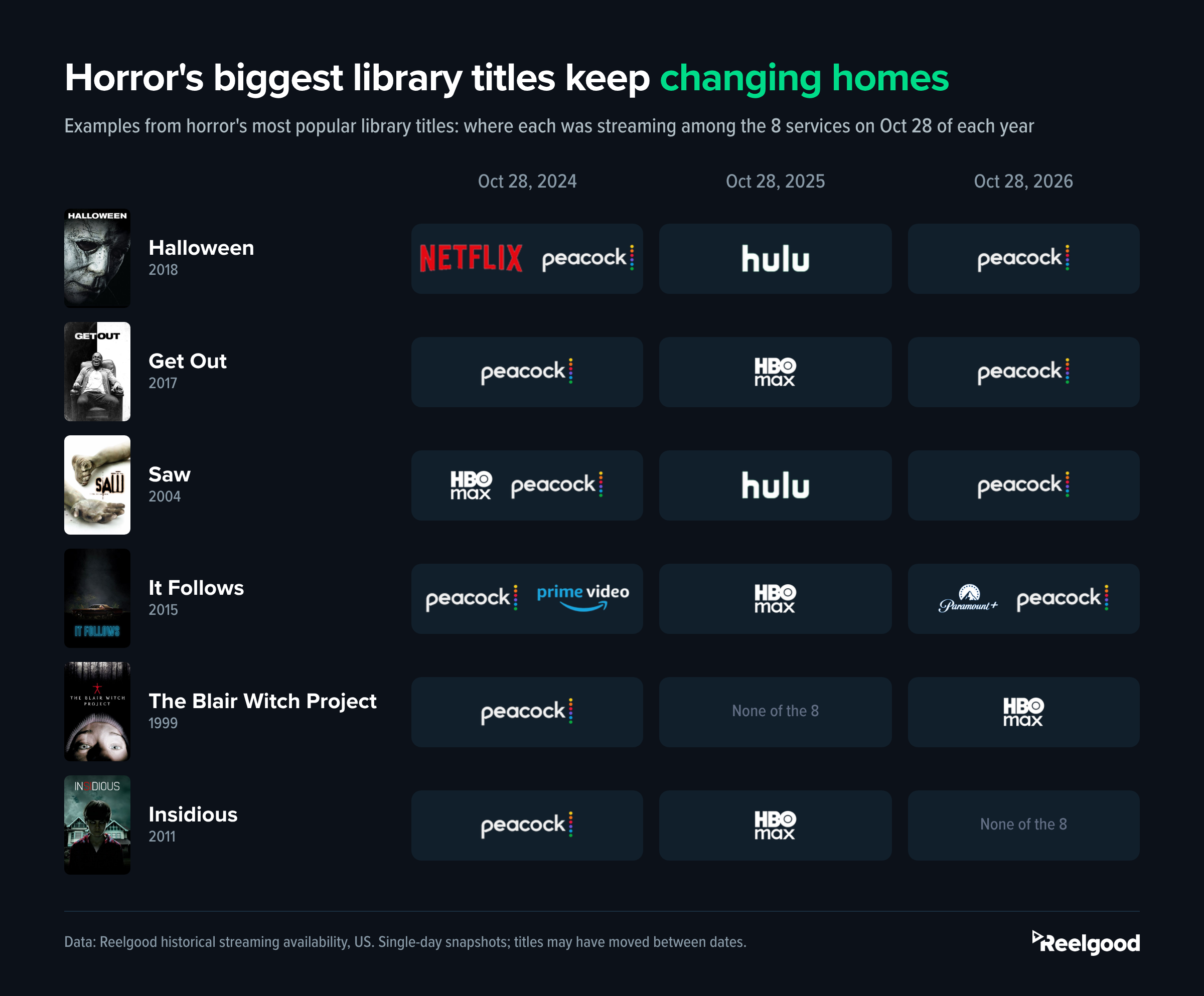
Halloween, Get Out and Saw were off Peacock in October 2025 and back by October 2026. Data: Reelgood historical streaming availability, US.
Those aren’t outliers.
Of today’s 100 most popular horror titles, 52 were streaming on these services on all three dates. Of those, 37 were added to, dropped by or moved between services along the way, and 22 changed in both years.
For a popular horror title, the competitive set can look different every Halloween.
These are single-day snapshots. Reelgood’s historical availability data dates every arrival and exit to the day.
For content acquisition and licensing teams, that full record of a title’s windows is the starting point for pricing the next license.
Peacock dropped 232 horror titles it carried alone. 164 haven’t landed on another major streamer.
None of the eight services carries those 164 today. Four were among horror’s 100 most popular titles in 2024: Abigail (2024), Halloween (2007), Insidious and The Final Girls.
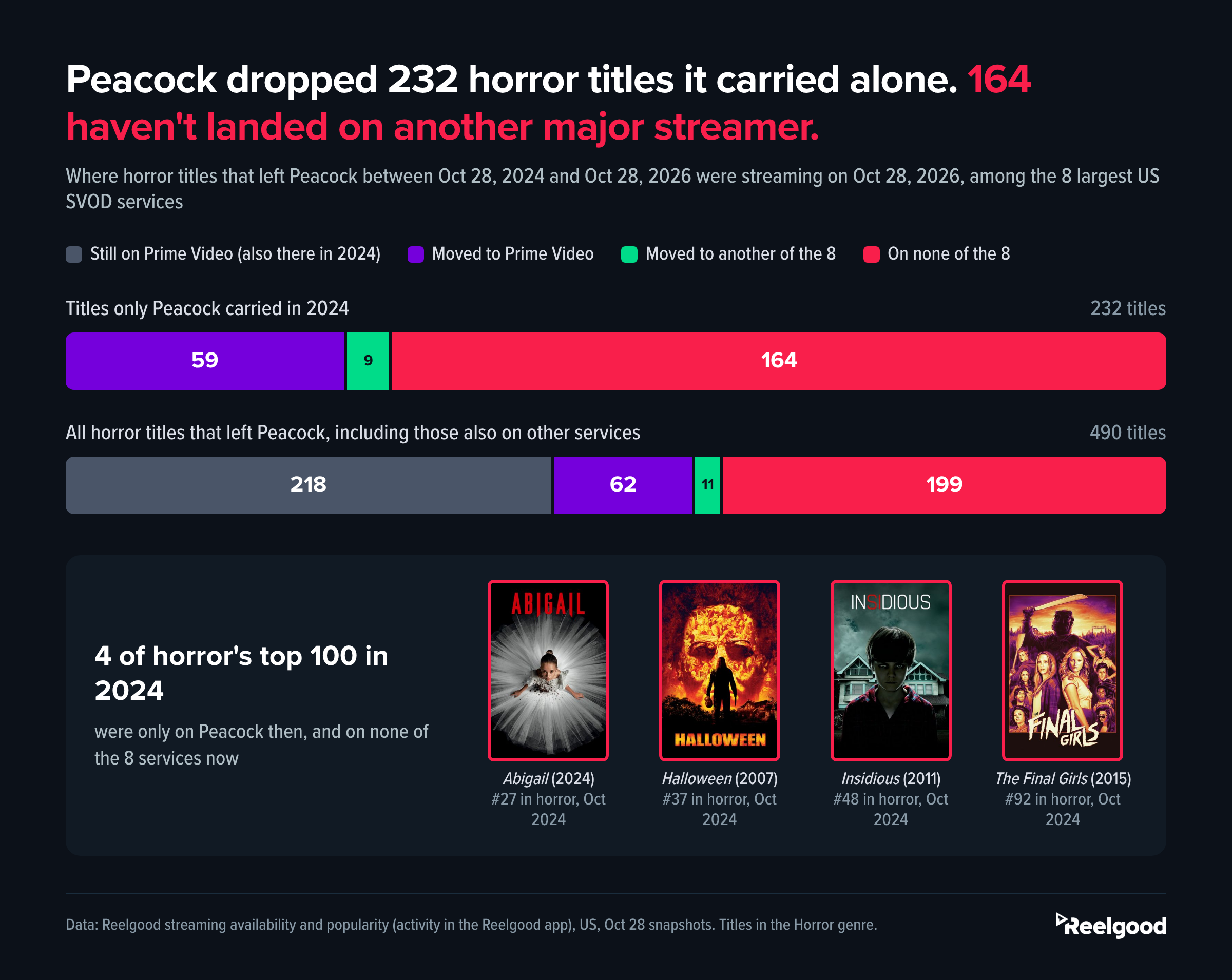
Of 232 horror titles only Peacock carried in 2024 and later dropped, 164 weren’t on any of the 8 services on Oct 28, 2026. Data: Reelgood, US.
For an acquisition team, that’s a short list of proven horror no major competitor holds right now. Some of these titles may stream on free or specialist services outside the eight covered here. Reelgood tracks those services too, so the same check can extend to them.
Let’s dig a little deeper.
Across all 490 horror titles Peacock dropped, 280 now stream on Prime Video. But 218 of those were already on Prime in 2024, so only 62 actually moved there. A few titles came back: six of Peacock’s titles in today’s top 100, including Halloween (2018), Get Out and Saw, had left by October 2025 and returned a year later.
The rest of Peacock’s catalog shrank faster than its horror. So horror’s share dipped to 10.2% in 2025, then rose to 11.3%, the largest two-year gain of the eight.
Netflix, Prime Video and Disney+ got scarier by adding horror
These are the only three services where horror’s share rose in both years. The gains are small but consistent. Netflix’s horror titles grew 24% (394 to 489) while its full catalog grew 16% (7,104 to 8,254). Disney+ went from 16 horror titles to 42 while its full catalog grew 38%. It still has the lowest horror share of the eight.
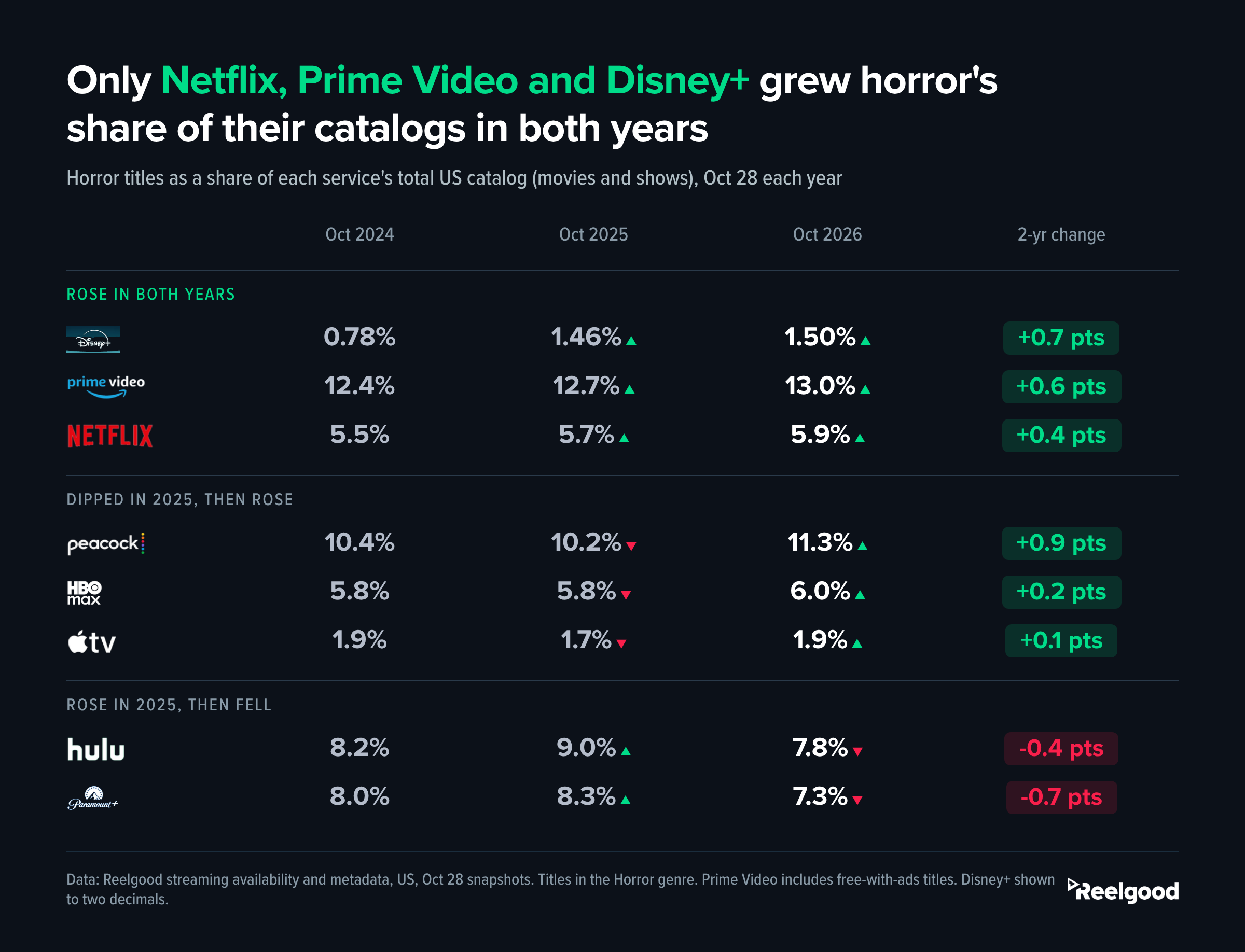
Horror’s share of the catalog rose in both years only at Netflix, Prime Video and Disney+. Data: Reelgood, US, Oct 28 snapshots, 2024 to 2026.
Hulu and Paramount+ went the other way, rising in 2025 and falling in 2026 to end below where they started. Hulu’s horror titles fell 24% (357 to 271) against a 20% drop in its full catalog. Paramount+ added a net 11 horror titles (134 to 145) while its full catalog grew 19%.
For competitive intelligence teams, the reason behind a share change matters as much as the change. Netflix and Peacock both got scarier, for opposite reasons: Netflix grew horror faster than its catalog, and Peacock cut horror more slowly than everything else.
Prime Video is adding slashers and serial killers faster than its catalog grows
Inside Prime Video’s horror catalog, slasher titles grew 76% (224 to 394) and serial-killer titles 68% (192 to 323). That compares with 52% for Prime’s horror overall (3,173 to 4,827) and 46% for its full catalog (25,507 to 37,131).
Some of that catalog growth likely reflects Amazon folding its free Freevee service into Prime Video (Deadline), and our Prime counts include titles available free with ads. That’s why we compare each tag with Prime’s own growth rather than reading raw counts.
Slasher and serial-killer titles also draw outsized interest.
They show up among horror’s 500 most popular titles about twice as often as their share of streaming horror: 14.4% vs. 8.1% for slashers and 13.4% vs. 6.8% for serial killers.
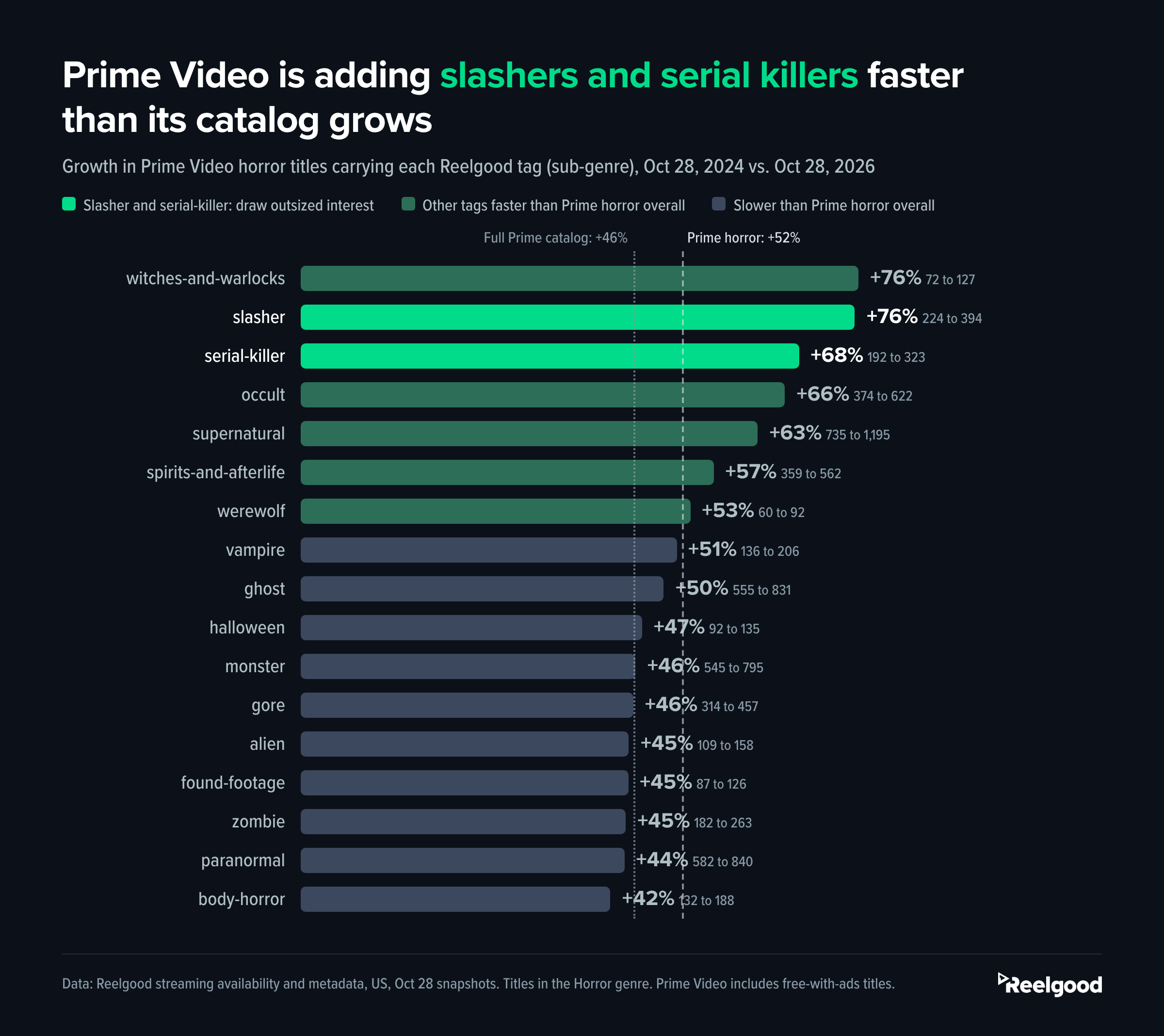
Slasher and serial-killer titles on Prime Video grew 76% and 68%, against 46% for Prime’s full catalog. Data: Reelgood taxonomy and availability, US.
Witches-and-warlocks titles also grew 76%, but from a much smaller base (72 to 127), and they haven’t drawn outsized interest as consistently.
Body-horror (+42%) and paranormal (+44%) grew more slowly than the catalog itself. They now make up a smaller slice of Prime Video than two years ago.
Tags come from Reelgood’s current taxonomy applied the same way to every snapshot, so the growth reflects titles added, not relabeling.
What “getting scarier” means for licensing and analytics teams
Horror’s most popular titles move constantly, and some leave the major streamers altogether.
A service’s horror share can rise because it added horror or because it cut everything else faster. None of that shows up in a raw title count. You need the dates, the catalog totals and the tags.
Want to see which proven horror titles no major SVOD carries right now? Or the full availability history behind a title you’re about to license? Email data@reelgood.com to talk with our data team.
Data: Reelgood Movie & TV Metadata & Streaming Availability Database, US, snapshots of Oct 28, 2024, Oct 28, 2025 and Oct 28, 2026. Services: the eight largest US general-entertainment SVODs: Prime Video (including titles available free with ads), Apple TV, Disney+, HBO Max, Hulu, Netflix, Paramount+ (Essential and Premium combined) and Peacock. Horror includes all titles carrying Reelgood’s Horror genre; tag counts are within those titles. Availability is shown as of each snapshot date; titles may have moved between snapshots. Popularity rankings are based on activity in the Reelgood app.
