When Project Hail Mary Hit #1, The Martian Wasn’t Streaming: Content Intelligence Takeaways for Streaming Marketers
When Project Hail Mary hit theaters and climbed to the top of the box office, the obvious follow-up watch was The Martian. Same author, Andy Weir. Same kind of stranded-astronaut, science-under-pressure story. But Houston had a problem; it wasn’t streaming anywhere.
That gap, and how often it repeats across the industry, was the center of my talk earlier this year at the inaugural StreamTV Marketers Summit in Denver. I walked through what we call data-driven content intelligence: using Reelgood’s catalog and availability data to:
Show streaming, studio, and platform marketers where their content actually stands against competitors, and where the audience opportunities are hiding in plain sight.
Here’s the talk, along with the key data points if you’d rather skim.
Key Takeaways
- Reelgood tracks over 4 million titles across 300+ streaming services worldwide, with up to seven years of historical availability data behind them.
- Of roughly 70,000 TV shows on the market, the top eight streamers carry only about 14,000. The other 54,000 sit across the long tail of smaller services, and 32,000 of those aren’t even available in the U.S.
- Movies show the same pattern at a bigger scale: about 33,000 titles sit on the major services, while almost 250,000 don’t, and half of those aren’t available in the U.S. at all.
- Every platform has a distinct content identity, in genre mix, season length, and how fast titles move from SVOD to AVOD, and that identity keeps shifting year to year.
- New releases create predictable demand spikes for related library titles. Teams without real-time availability data miss the window before a competitor fills it.
The Long Tail Is Bigger Than Most Marketing Teams Realize
Most content and marketing teams benchmark themselves against seven or eight competitors: the major subscription streamers everyone already tracks. That’s a fraction of what’s actually out there.
There are roughly 70,000 TV shows in the market today. The top eight streaming services hold about 14,000 of them. That leaves 54,000 titles spread across the long tail: Tubi, BritBox, Pluto, and the other 300-plus services Reelgood tracks, with 32,000 of those not even licensed for U.S. audiences.
Movies follow the same shape at a larger scale: about 33,000 titles sit on the major services, while nearly 250,000 don’t, and half of those aren’t available in the U.S. at all. As we found in our Streaming Iceberg analysis, most movies in circulation were never going to show up on a top-three catalog check to begin with.
For teams evaluating acquisitions, tracking competitor libraries, or looking for underused titles in their own catalog, that long tail is exactly where the differentiation lives.
Every Streaming Service Has a Different Genre Fingerprint, and It Keeps Shifting
Catalogs aren’t static, and they don’t move together.
Disney has been building out its crime catalog. Amazon Prime Video has been adding biography titles while Paramount+ has been trimming them. Netflix has been pulling back on international titles and leaning more into romance, while Hulu has been moving in the opposite direction. None of that shows up if you’re only looking at total catalog size.
Genre share by catalog tells the same story from a different angle. HBO Max and BritBox both carry an outsized share of documentaries relative to the rest of the market, while AMC+ carries far more horror in its catalog than any other major service, a different platform from the one in the opening story above.
Platform identity goes deeper than genre mix.
BritBox is 72% TV and growing 36% year over year. MGM+ is almost entirely movies (98%), with a catalog of roughly 2,200 films. Season length splits the same way: Netflix and Apple TV lean heavily toward shorter series, one to three seasons, while Peacock and Paramount+ carry a much larger share of long-running shows. At Paramount+, 12% of the catalog is series that have run seven seasons or more.
Windowing tells a similar story.
The average time a title spends on SVOD before moving to AVOD has shrunk from about six months to roughly two and a half months over the last four to five years, but that average hides real variation. Thriller and action titles move fast. Animation and children’s content can take close to three years to make the same jump.
We track this across more than 250 genres and subgenres, because top-line catalog counts miss almost all of this.
For anyone making licensing, acquisition, or positioning calls, knowing where you’re strong and where a competitor is stronger, at the genre level, is the difference between a real strategy and a guess.
New Releases Create Windows for Library Titles, If Someone’s Watching
A few years ago, we worked with one of the major streamers on a marketing strategy that wasn’t landing. When we looked at their Reelgood data, we found they had the largest horror catalog of any major streaming service. They had no idea. It became their marketing strategy for the rest of the year.
That kind of opportunity shows up constantly around new releases.
When Top Gun: Maverick came out, the original Top Gun saw a spike in engagement. When the Devil Wears Prada sequel released, the original landed back on Reelgood’s weekly Top 10 streaming list. And when Project Hail Mary hit theaters and opened at #1 at the box office, The Martian, sharing a screenwriter (Drew Goddard) and the same source author (Andy Weir), wasn’t streaming anywhere.
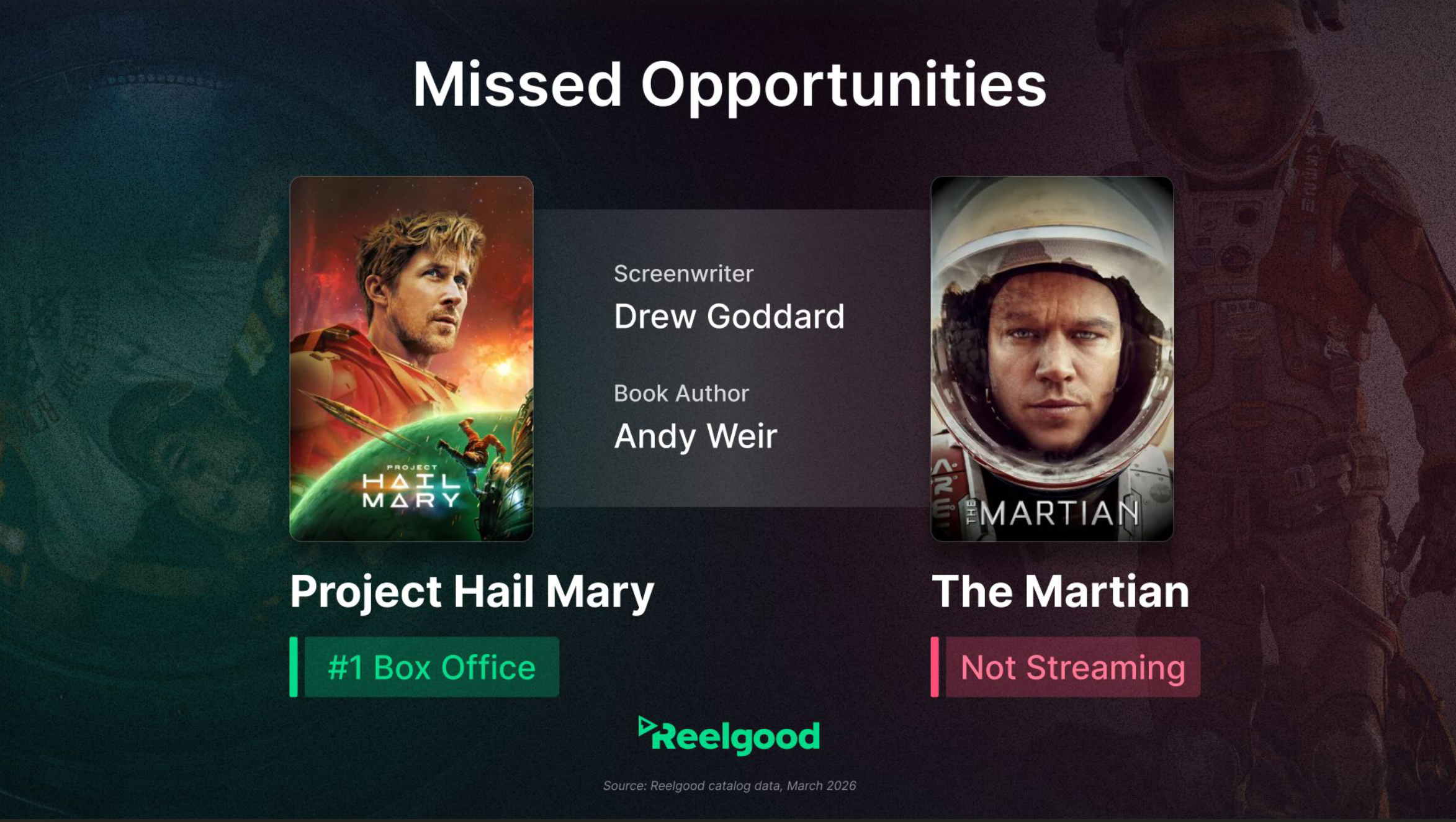
That gap was a missed opportunity somebody eventually noticed and fixed, but only after we flagged it publicly. In the weeks since, we’ve found the same pattern repeating: titles like the original Cape Fear and Lord of the Flies weren’t streaming anywhere as of our most recent check, despite renewed attention from new adaptations and franchise sequels.
Two upcoming releases point to the same gap.
Christopher Nolan’s The Odyssey was one of this summer’s biggest movies, and prior Nolan titles like Inception and Oppenheimer weren’t streaming as of the data we pulled. Steven Spielberg’s Disclosure Day, which draws obvious creative comparisons to E.T. the Extra-Terrestrial, was in the same position: the original hadn’t been available on any major subscription or ad-supported service in over three months.
None of this is visible from inside your own catalog. It only shows up when you’re tracking where titles are available, and where they’ve gone dark, across the entire market, not just the handful of services everyone already watches.
What This Means for Your Team
Three things are worth holding onto:
- The market is much bigger than the top eight or nine streamers most teams benchmark against,
- Every platform has its own strengths and gaps that only show up at the genre and title level, and
- New releases create timing windows for related library content that close fast once a competitor notices.
If your team is trying to find these opportunities in your own catalog, or track where they’re opening up across the market, that’s exactly what Reelgood’s data is built for.
Explore how content, licensing, and marketing teams are using it at our use cases page, or reach out directly at data@reelgood.com.
Data: Reelgood Movie & TV Metadata & Streaming Availability Database. Top 8 streaming services referenced throughout include Amazon Prime Video, Apple TV, Disney+, HBO Max, Hulu, Netflix, Paramount+, and Peacock.